Promoting 24/7 communication in concierge medicine can reassure patients that their decision to join your practice was a good one. Still, it can sometimes negatively impact a Physician’s emotional and mental health. While 24/7 availability in some form or another serves as a valuable selling point for a Concierge Medicine program or similar practice, it’s crucial to revisit your communication policy occasionally. A well-written, simple, often repeated, updated, and routinely revisited Communication Policy can establish the healthy boundaries you need in your practice for the journey ahead.
By Editor-in-Chief, Concierge Medicine Today | Disclaimer: This content, in whole or in part, along with its resources, links, mentions, and materials, does not offer legal, medical, financial, or any other professional advice. You assume all associated risks. We strongly encourage you to perform your own due diligence and work with a trusted advisor or professional or a competent attorney who understands your unique practice needs.
Today, we’re discussing why it’s crucial to routinely revisit your Communication Policy with a trusted professional or a competent attorney with knowledge of this space.
But first, let me say this to the Physician who needs to hear it:
- A well-written, often updated, and routinely revised Communication Policy is a form of self-care. Not only is it for the Physicians’ mental and emotional health, but it’s also for the Patients’ benefit.
- A well-written, often updated, and routinely revised Communication Policy helps maintain a healthy work-life balance, gives structure to your responses, and is critical to a successful marriage! In concierge medicine, a good communication policy and a secure messaging platform should free Physicians up to do what they do best. These two things working together should give you, your Practice and your Patients the freedom to respond to messages at their convenience, address questions promptly, and automatically document interactions in the patient’s EMR. Don’t look at them as a way to restrict communication. That’s what the rest of healthcare attempts to do. You’re different, and that’s okay.
- A well-written, often updated, and routinely revised Communication Policy is a set of personal rules that become a matter of professional conscience. Remember, “… it’s no longer about being the best Doctor in the world anymore, it’s about being the best Doctor FOR the world, FOR your Patients, and FOR your local community.”
- A well-written, often updated, and routinely revised Communication Policy can help you avoid regrets that might otherwise occur.
- A well-written, often updated, and routinely revised Communication Policy is a choice you make for yourself and will impact you and those closest to you.
 Patients often have high expectations.
I know this because I am one. However, I know my place in line and am willing to cave to a ridiculously restrictive policy, but only to a certain point. Then, “I’m out.”
Herein enters concierge medicine, which seems to show healthcare at large how to truly serve and meet a patient’s needs, but to a point as well.
You see, we work and live in a healthcare culture today dominated by “insider-itis.”
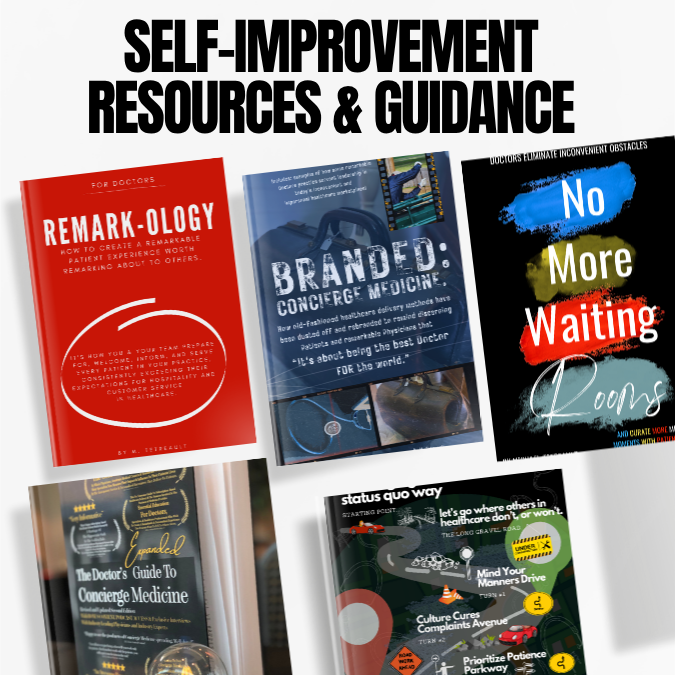
According to the book No More Waiting Rooms, “insider-itis” in healthcare refers to a medical office and practice culture that has become too accustomed to their insider way of doing things, leading to complacency, lack of empathy, resistance to change, and regular communication breakdowns.
You’ll know when insider-itis has infected a medical office and your teams’ culture when you hear phrases like “What’s your name again?”, “You’ll have to call …”, “I don’t see you on the schedule,” or “We’re not going to check you in for another 18-minutes.”
That last one just happened to my son and I this week!
To address insider-itis, some concierge medicine practices, plastic surgery offices, and even aesthetic-focused medical teams we’ve interviewed in the past year are revising their communication policies to make them less insider-focused and less restrictive than traditional, plan-reimbursed practice environments. Practice leadership also pays medical staff to attend semi-annual customer service training conferences [outside of healthcare] to learn best practices on hospitality, the importance of friendly greetings, and even simplifying a phone tree. They’re also seeking regular patient feedback and fostering a culture of empathy and responsiveness.
Establishing clear expectations regarding round-the-clock access isn’t easy, but ensuring effective communication between the Patient and the practice is essential. In concierge medicine, some Patients might have unrealistic expectations regarding communication, texting, and emails or believe they’ll now receive an instant response from their Physician. Acknowledging their feelings while providing clear, factual information is beneficial. However, healthy communication policies set the necessary boundaries between what’s expected of the practice or Physician and what happens when someone calls texts, or emails the practice.
If your patients have unrealistic expecations about your concierge medical practice communication consistency or availability, you may want to consider revising your Patient Agreement and updating your communication policy within that document with a trusted, knowledgeable professional or a competent attorney familiar with these subscription-based healthcare practices.
There will be those people in our lives and businesses who think the rules don’t apply to them. I call them bulldozers; we’ve all got them in our lives. They don’t care how many times you rebuild your guardrails. They’re going to bulldoze their way right through them to ensure their needs are met, no matter the cost of your mental or emotional health.
Tongue in cheek, they’re the exception for which the rule was written, right?
Here are some key questions to consider when revising, drafting, or updating your Communication Policy with a trusted professional or competent attorney:
- Does it need to clearly state how patients can contact the practice by phone, email, or secure messaging?
- Why is this important? This may help set expectations and reduce future confusion.
- Does the Communication Policy inform patients about the physician’s hours for questions?
- Why is this important? Setting boundaries around response times may help protect the Physician’s personal time and may prevent exhaustion, mental fatigue, or even burnout.
- Do you need to create automated or custom templates for common questions and answers?
- Why is this important? This may save time and ensure patients get the same information, which could build trust.
- Do you have permission and the ability to provide educational resources about general information on certain common conditions?
- Why is this important? Educating patients regularly may help them feel empowered and reduce the need for repetitive explanations during appointments.
- Does your Communication Policy establish a straightforward follow-up process, like scheduled check-ins or automated reminders?
- Why is this important? This may help keep patients engaged without overwhelming the Physician and/or his/her schedule.
Some other considerations you may want to discuss with your team may also include:
- Revisit and train all staff members on the updated version of your Communication Policy so that they can help manage expectations each and every day. They should know how to handle routine questions and when to escalate issues to the Physician.
- Technology should improve efficiency and streamline interactions, but only if you know how to use them. Does your team (and the Physician) know how to use the technology platforms on their device(s), and do these patient management systems help your practice organize requests, elevate issues, schedule, and send reminders?
- How does your practice encourage and permit patients to provide feedback on their communication experiences? Regular feedback from all team members may help improve future revisions of the Communication Policy and may show your patients a commitment to process improvement.
- Do you (and your team) know how to keep a professional tone in all communications, online, on devices, through secure messaging platforms, and in person? Training and discussing this topic among your team each month may help build trust and reassure patients about the quality of care and service they will receive.
- How often will you regularly check on how well your current communication policy is working? Are you ready to change it based on patient needs, staff input, and new technology?
Good Doctors Do It All. Great Doctors Delegate and Do What They’re Good At: Help Patients.
Conversations regarding sensitive health issues require a balance of empathy and directness. This is where secure messaging and technology platforms should be considered as well.
For example, a useful tool we came across (not an endorsement) in this context could be OhMD, which enhances a practice’s marketing and reassures patients about the safety of their health data while enabling straightforward communication. OhMD facilitates the documentation of text interactions, either through free PDF exports or direct integration with electronic medical records (EMR). This feature distinguishes practices using OhMD from those relying on complex patient portals.
Every patient should recognize that in Concierge Medicine or the like, their Physician may not always be available and that the practice may, from time to time, need to delegate specific responsibilities to other staff members. After all, it would also help if you had a break or vacation.
Some patients may depend too heavily on their doctors to address minor health questions that are more suited for an exam room than sent via email or text. These questions may not need to be resolved right away. What response will you or your team have to help manage these inquiries? Some Concierge Doctors and even consultant organizations also have to navigate these communication issues. Those individuals we’ve interviewed over the past year on this topic emphasize the importance of clarity around your Communication Policy. They mention that just because you wrote it five years ago doesn’t necessarily mean it works well for today’s instant-access culture.
For example, in cases of non-compliance to your communication policy, where some of your patients may text you in the middle of the night or expect near-immediate responses via email, voicemail, or texts sent two or even five times per day, that’s where an updated and well-written communication policy or pre-written or automated script or message in your secure messaging platform may need to come into play stating something like “I understand this is important for you. Let’s agree on appropriate times for non-emergency calls. Our hours are …”
According to TEBRA**, an all-in-one Electronic Health Record (EHR) and practice management solution, effective communication is inherently a two-way process. By utilizing the appropriate tools, healthcare practices can facilitate two-way texting for brief conversations between doctors and patients. However, healthcare providers must exercise caution to avoid sharing Protected Health Information (PHI) within these text messages.
RELATED STORY
Navigating HIPAA-compliant text messaging for better patient communication
Another consideration you may want to discuss with your team is how your practice ensure HIPAA compliance when texting patients. According to SigmaMD*, you may want to consider the following steps:
- Obtain Consent: Secure written consent from patients prior to sending text messages, ensuring that no PHI is included.
- Utilize Secure Systems: Select secure, encrypted messaging platforms to safeguard patient information.
- Alert About Risks: Include a disclaimer with each message that outlines the risks associated with unauthorized access to PHI.
- Adhere to Guidelines: Follow the regulations established by the Department of Health and Human Services (HHS) regarding texting practices.
- Managing Expectations:
- Handling Non-compliance
- Discussing Sensitive Topic
In summary, an effective Communication Policy can serve as a vital tool for both Physician self-care and improved patient communication. We hope this content has been helpful.
Citations
- *SigmaMD. (n.d.). Setting Boundaries With Patients: A Guide to Effective Communication in Direct Care. Retrieved from https://sigmamd.com/blog/setting-boundaries-with-patients
- **OhMD. (n.d.). Leveraging Text Messaging for Concierge and Direct Primary Care. Retrieved from https://www.ohmd.com/concierge-medicine-direct-primary-care/
Also For Your Consideration …
To assist the writing process, these Grammarly AI prompts were used:
Prompts created by Grammarly
– “Make it informative”
– “Simplify it”
– “Pick out my main point”
– “Improve it”
– “Make it friendly”
– “Paraphrase it”
– “Summarize it”
– “Make it persuasive”
Prompts w wrote
– “define what insider-itis is in medical offices”
– “pro tips for doctors to drafting a good communications policy to maintain effective care quality…”
Creating an effective communications policy is vital for doctors who aim to deliver exceptional care while preserving a healthy work-life balance. Here are some essential tips to consider:
1. **Clarify Communication Channels**: Specify the most effective methods for patient communication—whether through in-person consultations, phone calls, emails, or secure messaging applications. This clarity sets proper expectations and minimizes confusion.
2. **Establish Clear Boundaries**: Define your availability for patient interactions and communicate this to your patients. Setting these boundaries will help safeguard your personal time and prevent burnout, leading to better care.
3. **Utilize Templates and Standard Responses**: Develop templates for frequent inquiries and common issues. This approach not only saves time but also ensures consistency in your responses, alleviating the burden of drafting messages each time.
4. **Empower Through Education**: Equip patients with informative materials regarding their conditions and treatments. When patients are informed, it decreases the likelihood of repetitive explanations during appointments and fosters a sense of independence.
5. **Create a Follow-Up System**: Implement a structured follow-up process to reinforce patient care without overwhelming yourself. Automated messages or scheduled check-ins can keep patients engaged while managing your workload effectively.
6. **Train Your Team**: Ensure that your staff understands and adheres to the communication policy. They should know how to handle common inquiries and when to escalate issues, allowing you to focus on critical patient care.
7. **Leverage Technology**: Explore patient management systems that streamline scheduling, reminders, and communications. Effective use of technology can optimize your workflow and keep your interactions organized.
8. **Encourage Patient Feedback**: Regularly solicit patient feedback regarding your communication methods. Understanding their perspective helps refine your approach and demonstrates your commitment to quality care.
9. **Uphold Professionalism**: Maintain a professional tone in all communications. This practice builds trust and establishes a standard for interactions, reinforcing your dedication to patient care.
10. **Evaluate and Adjust**: Continually review the effectiveness of your communications policy. Adapt it based on feedback, evolving patient needs, or emerging technologies to ensure it remains impactful.
By embracing these strategies, physicians can enhance patient care quality while protecting their own well-being, ultimately achieving a sustainable work-life balance.
Source: Grammarly, AI; October 31, 2024.
Disclaimer: This content, in whole or in part, along with its resources, links, mentions, and materials, does not offer legal, medical, financial, or any other professional advice. You assume all associated risks. We strongly encourage you to perform your own due diligence and work with a trusted advisor or professional or a competent attorney who understands your unique practice needs.
Discover more from Concierge Medicine Today
Subscribe to get the latest posts sent to your email.
Categories: Healthy Leadership Practices