

The data on EHR distraction and patient trust is consistent and worth taking seriously. So is the simple leadership habit that costs nothing to change. Full attention is rare. Intentional eye contact is rarer. And according to the research, both matter more than most physicians realize.
By Editor-In-Chief | Concierge Medicine Today
 There is a moment most physicians recognize — though few talk about openly.
You are in the exam room. The patient is speaking. And your eyes are on their chart, the monitor, the lap top or some screen.
Now one could argue that A.I. Scribes or an in-person Scribe could help with this attention but that’s another story altogether for another day.
Back on point: You’re not looking at the patient because you don’t care. But because the system in place right now in your practice requires it. The EHR needs updating. The documentation won’t wait. You’ll forget something. The next patient is already in the hallway. Your schedule is overloaded today, and the list could go on. And so you type, and nod, and type again — all while the person sitting three feet away wonders, quietly, whether you actually heard them.
J. Henderson, a leadership author and communicator, recently offered a challenge that sounds almost too simple to matter: practice making eye contact with the people in your life. Not a glance. Not a quick acknowledgment. Actual, intentional eye contact.
His observation and advice is direct — we are looking down too much. Scrolling, texting, distracted. And it has become so normal we barely notice it anymore.
For most healthcare professionals, that is a lifestyle observation. For physicians, it is a clinical and relational reality with documented consequences.
WHAT THE RESEARCH ACTUALLY SHOWS
The evidence on screen time in clinical encounters is nothing to miss — and worth taking seriously.
 A study published in the Journal of General Internal Medicine found that physicians spent approximately 37% of their time in the exam room facing the computer screen rather than the patient. In some practice settings, that figure was higher. (Arndt et al., 2017, Journal of General Internal Medicine)
Research published in Patient Education and Counseling documented that increased electronic health record use during patient visits was associated with reduced patient satisfaction scores and diminished perception of physician attentiveness — regardless of the clinical quality of care delivered. (Ratanawongsa et al., 2016, Patient Education and Counseling)
A separate study in Health Affairs found that primary care physicians spent nearly two hours on EHR documentation for every one hour of direct patient care. (Sinsky et al., 2016, Health Affairs)
The screen is not the villain. Documentation matters. Clinical accuracy matters. But the data is consistent: when physician attention is divided between the patient and the screen, patients feel it — and the relationship suffers for it.
WHY THIS MATTERS MORE IN CONCIERGE MEDICINE
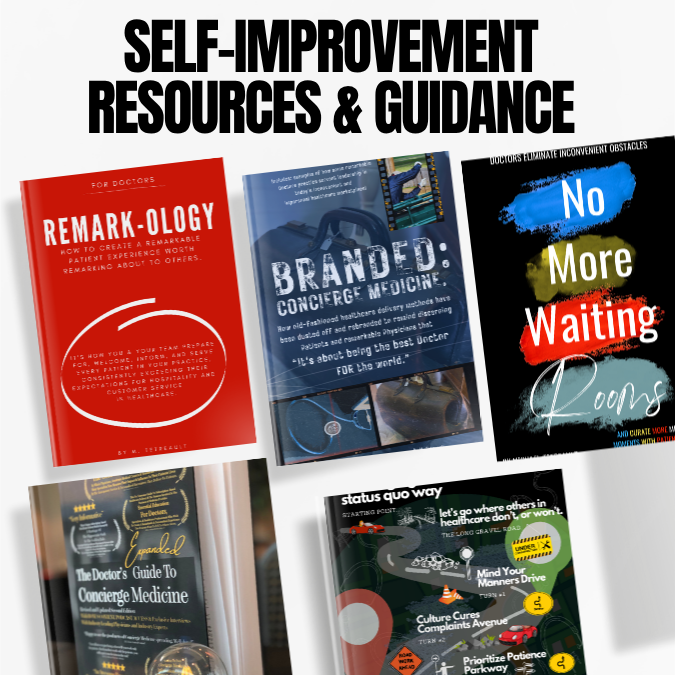
 I recently wrote an entire book last year (2025-2026) about the importance of the non-verbal communication inside concierge medicine and lacking in most primary care, pediatric and so called ‘patient-first’ practices today. It’s called Remark-ology.
The concierge and membership-based medicine model was built, in part, as a structural answer to this problem. Smaller patient panels. Longer appointment times. Fewer administrative interruptions. The explicit promise of a physician who is present.
But as you know, that promise is only as strong as the moment of actual presence in the room.
Back to Henderson’s point earlier — everyone wants to feel seen, and that feeling seen starts with someone actually looking at you — and it is not a soft observation. It is the foundational value proposition of relationship-driven medicine, stated plainly.
In fact, the American Academy of Family Physicians has documented that patient trust is among the strongest predictors of treatment adherence, health outcomes, and long-term care continuity. (AAFP, Annals of Family Medicine) Trust is built incrementally, in small moments — and eye contact is among the most fundamental of those moments.
A study published in Eye — the journal of the Royal College of Ophthalmologists — found that the optimal duration of eye contact for conveying attentiveness and building rapport is approximately three seconds. Not a stare. Not a glance. An intentional, human acknowledgment that the other person is present and worth your full attention. (Binetti et al., 2016, Eye)
THE LEADERSHIP DIMENSION
We talk a lot in concierge medicine about leadership and how concierge medicine physicians are taking this role on in their communities because their chosen business model now permits (and often requires) them to set the example FOR others to follow.
 What we’ve observed over the years in this healthcare industry is that this is not only a patient care issue, it is a leadership issue.
Physicians lead teams. They lead staff interactions, family conversations, colleague consultations, and community relationships. In each of those contexts, the same dynamic applies.
The screen — whether a phone, a tablet, a workstation, or a laptop — competes for attention that human relationships require. And in an era of ambient distraction, the deliberate choice to look up is itself a leadership act.
In my opinion, Henderson framed it well: you don’t need a grand gesture to encourage the people around you. Sometimes the most powerful thing you can offer someone is your full attention.
For Doctors, that reframe deserves to land with some intensity and weight. You see, you entered medicine, in most cases, because you wanted to know your patients — not just treat them. The administrative architecture of modern healthcare has worked against that instinctual desire for years. The concierge and membership model was designed, in part, to restore it.
But no practice model restores what only a physician can choose to give: the decision, in this moment, with this patient, to put the screen down and look up.
A SIMPLE CHALLENGE FOR DOCTORS THIS WEEK
I think at the end of the day the application and original challenge is worth adopting directly into your practice — regardless of the excuses we may find to dilute the challenge.
This week — in the exam room, in the hallway, at the nurses’ station, at the office, at the dinner table, at home — practice making intentional eye contact with the people in your life. Not a glance. Not a quick acknowledgment. Actual presence.
It will feel forced, awkward and deliberate at first. That is the point. Attentio n, in a distracted world, has to be chosen.
The patients and people sitting across from you already know what it feels like when a physician is somewhere else in the room. Most of them have experienced it many times. Most of us unfortunately have come to expect it.
Give them something different. Look up. Be present. Let them feel seen.
That is, after all, what they came for.
FOR YOU, FOR DOCTORS,
Michael Tetreault
Editor-In-Chief
Concierge Medicine Today
Sources & Citations
- Arndt, B.G., et al. “Tethered to the EHR: Primary Care Physician Workload Assessment Using EHR Event Log Data and Time-Motion Observations.” Annals of Family Medicine, 2017. pmc.ncbi.nlm.nih.gov
- Ratanawongsa, N., et al. “Association Between Physician Computer Use and Patient Satisfaction.” Patient Education and Counseling, 2016. pubmed.ncbi.nlm.nih.gov
- Sinsky, C., et al. “Allocation of Physician Time in Ambulatory Practice.” Health Affairs, 2016. healthaffairs.org
- Binetti, N., et al. “Pupillary Contagion and the Optimal Duration of Eye Contact.” Eye, 2016. nature.com/eye
- American Academy of Family Physicians. “Patient-Physician Relationship.” Annals of Family Medicine. aafp.org
- Henderson, Jeff. Know What You’re FOR. Zondervan, 2019. As referenced in original LinkedIn content, 2026.
This article is published for educational and informational purposes only. It does not constitute medical, legal, or professional advice. © 2007–2026 Concierge Medicine Today, LLC. All rights reserved.
Discover more from Concierge Medicine Today
Subscribe to get the latest posts sent to your email.
Categories: National Headlines