
How CMT’s Leadership Hub Infographics Help Physicians Build Smarter, More Sustainable Practices — Starting With How They Use Their Time
By the Editorial Team | Concierge Medicine Today
 There is a moment many physicians recognize — the one where you realize that working harder is no longer the answer.
The patients are still waiting. The paperwork is still piling up. The inbox still isn’t empty. And somewhere between clinical excellence and operational chaos, the very reason you went into medicine starts to feel distant.
That moment, uncomfortable as it is, may also be the most important one of your career.
It is the moment when physicians who lead — not just practice — begin to see their time, their systems, and their practice design differently.
That is precisely what the CMT Leadership Hub’s growing library of infographics was built to support. And that is exactly what the DocPreneur Leadership Podcast every week continues to explore with our industry-specific guests — including in a recent episode that dives into what time management really means for the physician-entrepreneur.
What the Infographics in CMT’s Leadership Hub Are Actually Showing You
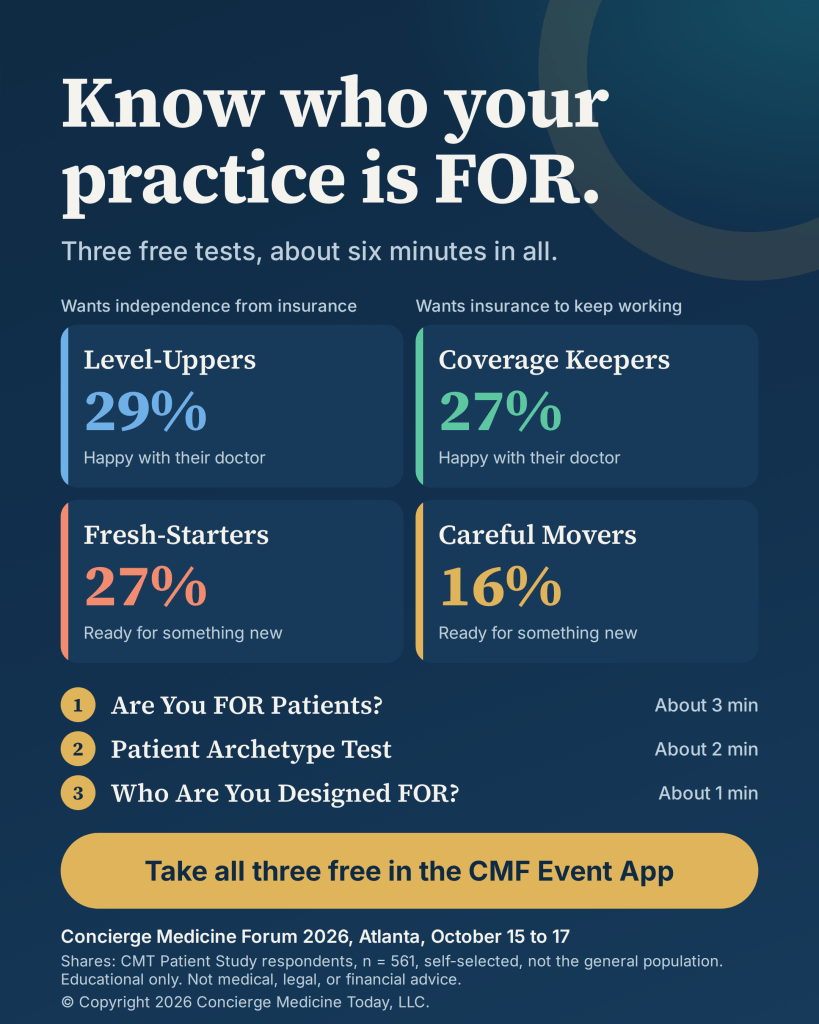
The infographics housed at conciergemedicinetoday.net/lead/infographics are not decorative. They are distilled intelligence — curated carefully from years of patient surveys, physician polls, industry data, and practice research — translated into visuals that help you and your team cut through the noise faster.
They span several core areas that every concierge and membership-based physician should be thinking about:
 The Concierge Medicine Shift — A foundational visual that captures what is actually driving the movement toward relationship-driven care. Not hype. Not trend-chasing. A structural shift in what physicians and patients are both looking for from the healthcare relationship.
- What Successful Concierge Medicine Actually Looks Like — One of the most practical visuals in the library. It breaks down the mindset, culture, and operational posture that defines practices that sustain — versus those that struggle. Most physicians are surprised by how much of it is not clinical.
- Healing with Hospitality in Healthcare — A visual that reframes the patient experience through the lens of hospitality. The lesson: patients often evaluate their care through service moments long before they evaluate clinical outcomes. The feeling of being known, welcomed, and respected matters more than most practices are designed to acknowledge.
- Membership Medicine 101 Series — A multi-part educational series covering the fundamentals of how concierge and membership models are structured, what drives patient enrollment, what patients are actually paying for, and where most new practices make avoidable early mistakes.
- Training Costs and Retention — Two companion visuals that illuminate one of the most underappreciated financial pressures in running a practice: the cost of losing and replacing good people. The data makes a compelling operational case for investing in team culture and stability rather than cycling through staff.
- Patient Burnout Series — One of the most clinically and operationally relevant sets of visuals in the entire library. Drawing from multiple years of patient survey data, these infographics trace the specific reasons patients disengage — from feeling rushed to feeling anonymous to feeling like their physician simply didn’t have time for them. If you read one series before your next team meeting, make it this one.
- Patient Trust Data — A visual that should be posted in every physician’s office. Patient trust is not assumed. It is built — through consistency, availability, and the quality of the relationship over time. This infographic quantifies what that looks like in membership medicine and why it matters to retention.
- Why Patients Leave — Blunt, data-driven, and essential. The infographic surfaces the real reasons patients terminate their membership or walk away from practices — and almost none of them are clinical. They are relational, operational, and experiential.
- Patient Relationship and Generational Data — A demographic lens on who is joining concierge practices, why they are choosing to do so, and how expectations shift across generations. Understanding your patient population is not a marketing exercise. It is a clinical and operational one.
- CMT Annual Poll Series — A rotating set of physician and patient polls from CMT’s ongoing industry research. These visuals track sentiment, practice decisions, and emerging concerns across the field in real time — giving physicians a window into what their peers are experiencing and what patients are saying when no one is watching.
The Time Problem That Nobody Talks About Honestly
Most time management advice given to physicians is borrowed from the corporate world and applied poorly. It assumes you have a 9-to-5 schedule, a single employer, a fixed set of deliverables, and a team built to support your productivity.
Physicians in concierge and membership medicine often have none of those things — especially early on.
What they do have is something more valuable: control. And the failure to exercise that control intentionally is the single most common operational mistake CMT sees across practices of every size.
Pro Tips: What the CMT Infographics Are Actually Telling Physicians About Time Management Today
- The physicians who protect their time structurally outperform those who protect it aspirationally. Saying “I need more time” changes nothing. Designing your schedule so that your highest-value activities — patient care, strategic thinking, team leadership — cannot be crowded out by administrative drift is a different thing entirely. The practices that do this well build it into their systems. They do not rely on willpower.
- Patient burnout and physician burnout are often caused by the same root problem. The patient burnout infographics in the CMT Leadership Hub reveal that patients leave practices when they feel rushed, ignored, or like a transaction. Physicians burn out when they feel the same way about their own work. Both problems trace back to the same failure: a practice that has prioritized volume over relationship. Fixing the design fixes both.
- Your first hour of the day is a leadership decision, not a scheduling one. Physicians who begin their day reactively — responding to messages, handling whatever surfaced overnight, putting out fires — consistently report lower satisfaction and lower practice performance. Physicians who protect their morning hours for patient care, strategic review, or team alignment report the opposite. The data does not care about your personal style. It reflects your design choices.
- The cost of underinvesting in your team shows up in your schedule. The training cost infographics in the CMT Leadership Hub exist for a reason. A destabilized team creates physician time loss that rarely gets accounted for — unexpected call coverage, rework, patient complaints, hiring cycles. Every hour spent replacing someone who left is an hour not spent with patients or building the practice. The math is not complicated.
- Membership models are not automatically time-protective — they require active design. One of the most common misconceptions CMT encounters is that transitioning to a concierge or membership model automatically solves the time problem. It does not. It creates the conditions for solving it. The practice still has to be designed — in terms of panel size, appointment structure, communication protocols, and team roles — for the physician’s time to actually be protected. The infographics in the Membership Medicine 101 series speak directly to this.
4 Action Steps: How to Start Using These Resources This Week
The CMT Leadership Hub and infographic library are not meant to be consumed passively. They are built for application.
Here is how to put them to work immediately:
Step 1: Visit the infographic library and spend 20 minutes with it — not 7 seconds. Go to conciergemedicinetoday.net/lead/infographics. Do not skim. Sit with the patient burnout data. Read the “Why Patients Leave” infographic twice. Ask yourself whether any of the patterns described are already present in your practice.
Step 2: Audit one week of your actual schedule — not your ideal schedule. Block thirty minutes at the end of this week and reconstruct how your time was actually spent. Compare it against how you intended to spend it. The gap between those two pictures is your operational challenge. The infographics will help you name what is driving it.
Step 3: Share the Patient Trust and Why Patients Leave infographics with your team. These visuals are most powerful when discussed in a team setting. They surface conversations that individual physicians often cannot have alone. Use them as a discussion prompt at your next staff meeting. Ask your team: “What in here sounds familiar?”
Step 4: Identify one system you will build — not one habit you will try. Habits require repetition and willpower. Systems require design. The difference matters. Decide on one structural change — a protected block on your calendar, a communication protocol with patients, a delegation decision with your team — and build it this month.
The Bigger Picture
Time is not a resource physicians lack. It is a resource that too few physicians have learned to lead.
The infographics in CMT’s Leadership Hub are not just data visualizations. They are mirrors. One of my mentors routinely says “Show me your calendar and your bank account and I’ll show you where your priorities are.” ~D.M., 2026
The graphics and visuals we’ve put together over the years reflect what concierge and membership medicine looks like when it is working — and what it looks like when the same old operational problems from traditional practice are simply replicated and used in a new model. The patient data, the physician poll data, the training cost data — all of it points to the same underlying truth: sustainable, relationship-driven practices are not accidents. They are designed. And, the data is already telling you something you should do.
Explore the full CMT Leadership Hub Infographic Library at conciergemedicinetoday.net/lead/infographics.
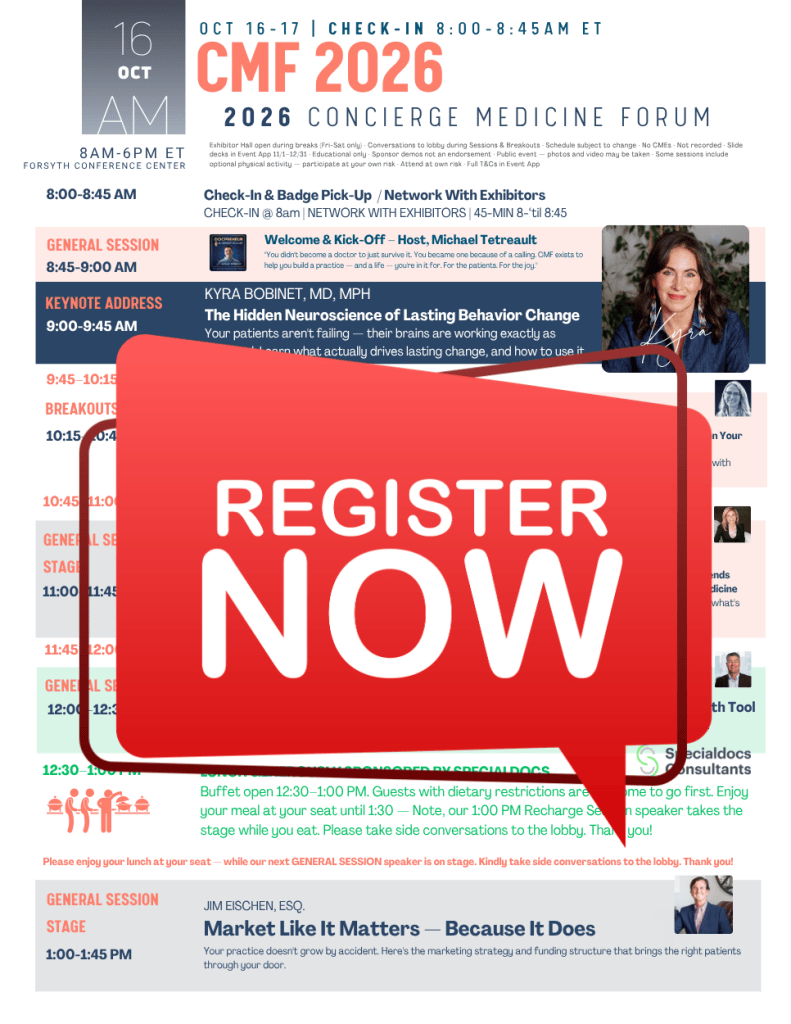
The Concierge Medicine Forum — the industry’s annual leadership gathering — returns October 15–17, 2026 in Atlanta, GA. Learn more at conciergemedicinetoday.net/live-events.
Content is for general informational and educational purposes only. It does not constitute medical, legal, financial, or professional advice. © 2026 Concierge Medicine Today, LLC. All rights reserved.
Discover more from Concierge Medicine Today
Subscribe to get the latest posts sent to your email.
Categories: National Headlines