

Physicians who transition because they’re exhausted and hoping the model will fix everything — those physicians often discover that concierge medicine doesn’t solve problems you carry in with you. It just gives you a quieter room to sit with them in.
By Editor-In-Chief, Concierge Medicine Today
 Here’s a conversation we’ve had more times than we can count.
A physician reaches out — usually after a conference, sometimes after a podcast episode, occasionally just cold, out of nowhere — and says some version of the same thing: I’m done with this model. I know I want out. I just don’t know if concierge is actually the right move for me, or if I’m just exhausted and romanticizing something I don’t fully understand.
That kind of honesty takes guts.
And it deserves a real answer — not a pitch, not a checklist, not a glossy brochure.
So here is what we actually know, after nearly two decades of covering this industry: the transition from traditional medicine into concierge or membership-based care is one of the most consequential decisions a physician will make. It can be one of the best. It can also be done wrong in ways that are painful and expensive. The difference between those two outcomes almost always comes down to one thing — how carefully and honestly the physician thought it through before they made the leap.
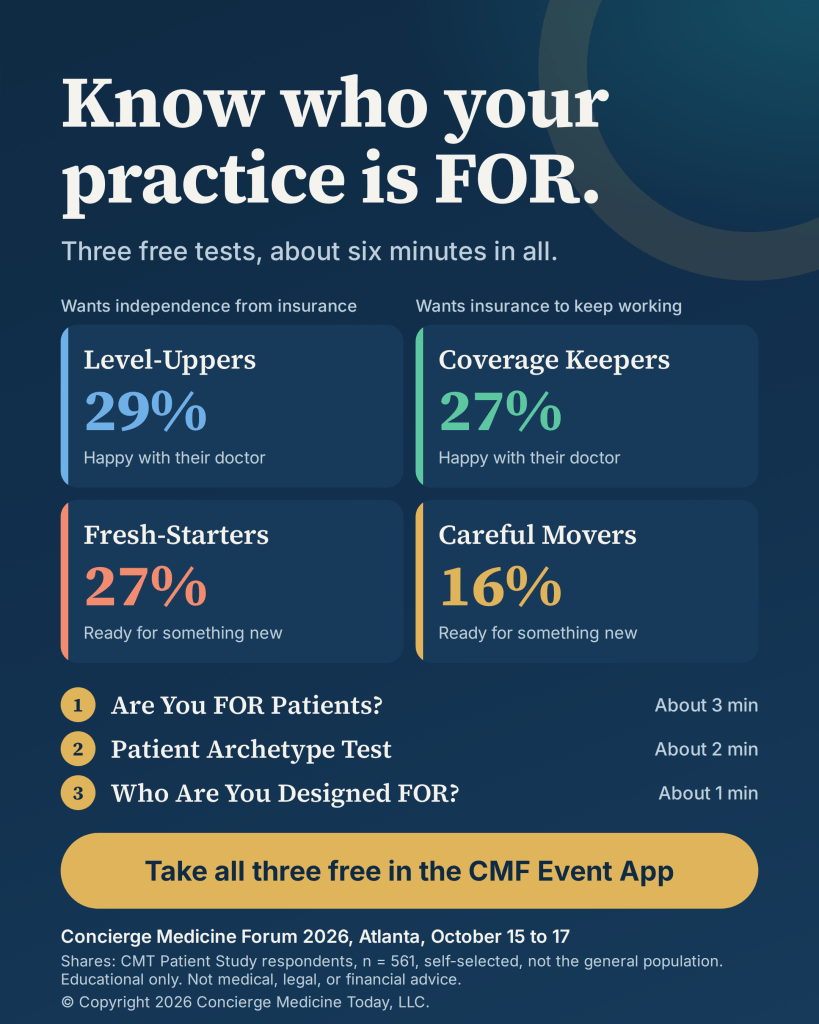
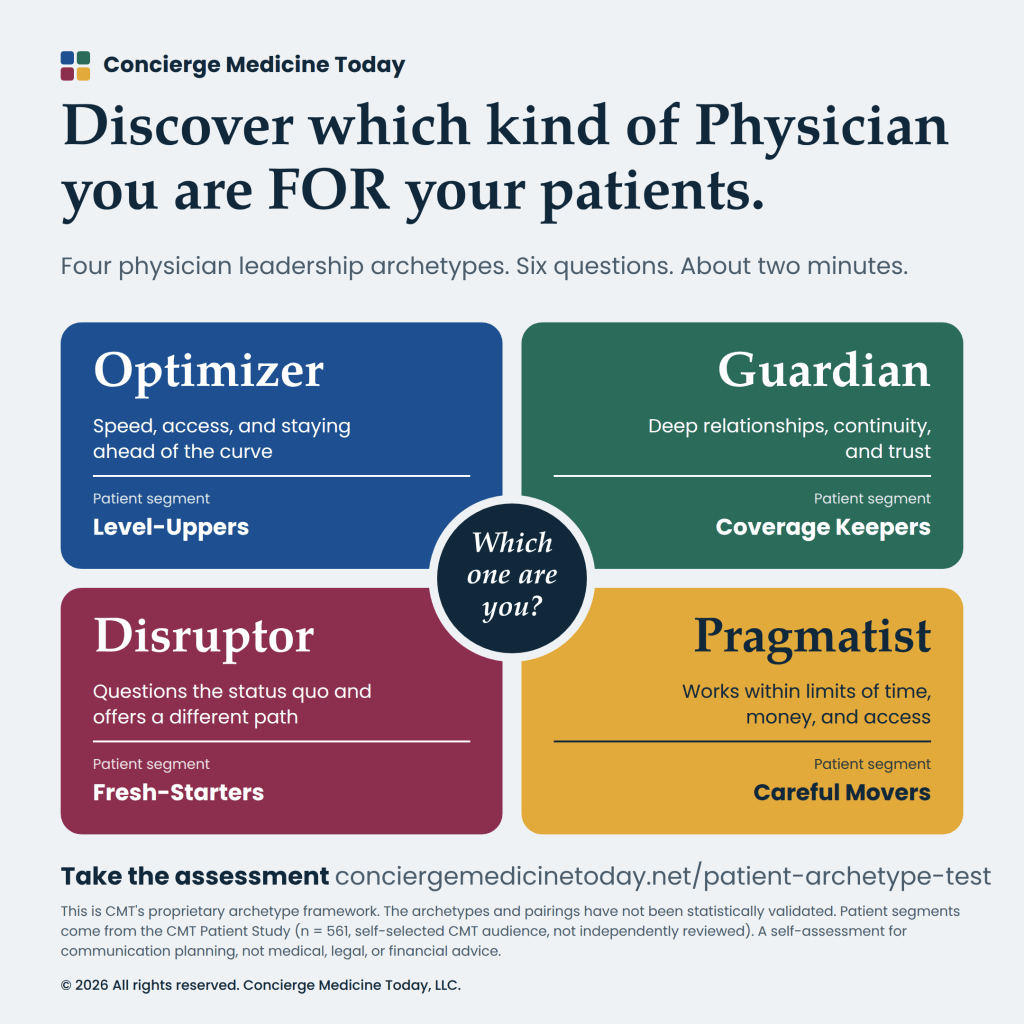
That’s what the infographics and visuals in CMT’s Leadership Hub were built to help with. And that’s what this article is going to walk you through.
Why Physicians Are Moving — and Whether the Reasons Are the Right Ones
Let’s start here, because this is where a lot of transitions go sideways before they even begin.
 The honest reality is that most physicians who start asking about concierge medicine are doing so from a place of pain. They’re burned out. They’re frustrated. They’re angry at a system that has commoditized their time and their relationships with patients in ways that feel fundamentally at odds with why they went into medicine.
That pain is valid. It is also, by itself, a dangerous reason to make a major business decision.
According to the American Medical Association’s most recent national data, 43.2% of physicians reported at least one symptom of burnout in 2024. Among family medicine physicians — the specialty most commonly exploring membership models — that number was 46.4%. A separate AMA survey found that between 2021 and 2022, 40% of physicians said they had moderate interest in leaving their current organization, were likely to do so, or would definitely do so within two years. The Medical Group Management Association found in a September 2024 poll that 27% of medical groups had a physician leave or retire early due to burnout that year.
All of that is real. And we’re not dismissing it. But the question worth asking — before you do anything else — is this: Am I attracted to concierge medicine because it aligns with how I want to practice, or am I attracted to it because I want to escape?
Those are different answers. And they lead to different outcomes.
Physicians who transition because they genuinely want smaller patient panels, deeper relationships, more time, and the operational independence that membership medicine requires — those physicians tend to thrive. Physicians who transition because they’re exhausted and hoping the model will fix everything — those physicians often discover that concierge medicine doesn’t solve problems you carry in with you. It just gives you a quieter room to sit with them in.
Sources: American Medical Association National Physician Comparison Report, 2024; AMA, “40% of Doctors Eye Exits,” 2023; Medical Group Management Association MGMA Stat Poll, September 2024.
What the Data Actually Shows About Concierge Medicine’s Growth
Here’s what’s happening in this industry — independently verified, not from our own promotional materials.
The global concierge medicine market was valued at approximately $21.1 billion in 2023 and is projected to reach $38.9 billion by 2032, according to DataHorizzon Research. In the United States, Grand View Research projects domestic market growth at 10.33% annually through 2030. And CMT’s own research — based on ongoing interviews with physicians, consultants, and investors since 2007 — puts the number of concierge physicians practicing in the United States at approximately 12,000 today, a figure widely cited by Physicians Practice and Medical Economics. In 2005, there were roughly 150.
The trajectory is not ambiguous. But growth in a market doesn’t mean every entrant succeeds. And the physician who understands why the successful practices work is in a completely different position than the one who just sees an attractive model and jumps.
Sources: DataHorizzon Research, April 2024; Grand View Research, U.S. Concierge Medicine Market Report, 2024; Concierge Medicine Today physician research, cited in Physicians Practice.
The Transition Paths — And the Honest Pros and Cons of Each
 There is no single way to make this move.
Medical Economics and ECG Management Consultants have both documented the primary pathways physicians use, and each one involves real tradeoffs.
Converting your existing independent practice.
- This is the most common path for physicians who already have an established patient base and want to retain as much of it as possible while shifting to a membership model.
- The advantage is continuity — you know your patients, your community, and your market.
- The honest challenge is that the conversion process is operationally demanding while your practice is still running. You are building the new engine while the old one is still running.
- ECG Management Consultants identifies this time and management pressure as one of the most common obstacles to a clean conversion.
- You will also need to communicate the change to your entire patient base, and some patients will choose not to follow you into the new model. Planning for that reality — financially and emotionally — is not optional.
Joining an established concierge practice or network.
- This path, documented by organizations like MDVIP, SignatureMD, Concierge Choice, PartnerMD and Specialdocs Consultants (listed in random order), offers the fastest operational runway.
- The systems are already built.
- The staff has experience with multiple variations of membership medicine transitions.
- The patient experience has been designed and refined.
- The tradeoff is somewhat autonomy — you are entering someone else’s model (kind of), and whatever organization you decide to help you needs to fit your clinical philosophy and personal values, or the move will feel like a different version of some of the same constraints.
Starting from scratch in a new market.
- This is the highest-risk, highest-potential path.
- It requires the most capital, the clearest business plan, the most entrepreneurial skillset and the strongest tolerance for uncertainty in the early months or first few years.
- It also gives you the most freedom to build exactly the kind of practice you want — but not without financial risk.
- ECG Management Consultants recommends a thorough market assessment — geographic, demographic, and competitive — before this path is chosen.
- But here’s the thing, the concierge model like this one can work in many markets. But beware, price too low (or too high) and you’ll quickly learn that it does not work equally in all of them.
Hybrid and segmented models.
- Some physicians start by offering concierge-level services to a subset of their existing panel while maintaining their traditional practice for the remainder. This can serve as a transition vehicle or a permanent structure, depending on the physician’s goals.
- The complexity of managing two operational models simultaneously is real, and it deserves honest assessment before proceeding.
Sources: ECG Management Consultants, “Five Steps to Building Your Concierge Medicine Practice,” 2024; Medical Economics, “Starting Strong: What Physicians Need to Launch a Concierge Practice”; Medical Economics, “Pathways to Concierge Medicine”; PartnerMD, “How Doctors Transition to Concierge Medicine.”
What the CMT Infographic Library Is Telling You About What Makes These Practices Work
This is where the visuals in CMT’s Leadership Hub go beyond inspiration and into operational intelligence.
 The patient retention data in our infographic library — drawn from years of patient surveys and practice research — is consistent on one point: patients in concierge and membership practices stay when they feel genuinely known. Not just seen on a schedule. Known. Their physician understands their family, their history, their concerns beyond the presenting complaint. The infographics on patient trust, on why patients leave, and on what drives membership retention all point to the same underlying dynamic.
A panel of 200 to 700 patients, as compared to the 2,000-plus that traditional primary care commonly carries, is not just a lifestyle adjustment for the physician. It is the structural condition that makes that quality of relationship possible in the first place. Research published in BMC Health Services Research and cited in JMCO’s concierge market analysis confirms that higher continuity of care is associated with lower healthcare costs, reduced hospital visits, and improved chronic disease management.
The infographics on hospitality in healthcare, on what successful concierge medicine actually looks like, and on the patient experience design principles that drive retention — all of these are operational inputs, not motivational content. They are the difference between a physician who builds something sustainable and one who builds something that looks good for eighteen months and then struggles.
Sources: BMC Health Services Research, cited in JMCO, December 2025; Concierge Medicine Today Leadership Hub infographic library, conciergemedicinetoday.net/lead/infographics.
The Practical Questions You Need to Answer Before You Move
 Please note, we’re not financial advisors. We’re not attorneys. We’re going to say that plainly and mean it, and we’ll say it again at the bottom of this article. But we can tell you what questions we’ve heard and watched physicians fail to ask — and later wish they had.
What does your market actually support?
Membership fees for concierge practices typically range from $1,500 to $20,000 annually, according to STAT Medical. Of note, DPC practices generally run lower — and that gap matters more than most physicians starting out realize. The question is not the brand you use, the terminology you prefer, or what the practice down the road is charging. It is what your specific market, patient demographic, and competitive landscape will actually sustain at a panel size that makes financial sense for you. This is a lesson CMT has watched a lot of physicians learn the hard way — particularly in DPC, where the instinct to offer a so-called affordable primary care price tag and tout accessibility often leads to undervaluing the service entirely in the mind of the patient and consumer. We get it. Pricing too low feels like humility. But in business, like in your practice, a service that is priced too low doesn’t just leave money on the table — it creates a trust gap between the provider and the patient that is very hard to close later.
The business world figured this out a long time ago. A study published in the Journal of Marketing Research found that when two identical products were priced at $10 and $40, the $40 product was consistently rated as higher quality, more durable, and more worth buying — even though nothing about the product had changed. (Highly Persuasive) When quality cannot be easily evaluated before purchase, price becomes a proxy for quality. (Highly Persuasive) In medicine, where a patient is choosing someone to trust with their health and their family’s wellbeing, that dynamic is not weaker than in consumer goods — it is stronger. Apple has built one of the most studied pricing strategies in business history around exactly this principle: premium pricing shapes how buyers judge quality and trust, and over time, steady pricing builds customer loyalty that survives competitive pressure. (NewswireJet) A concierge or DPC practice priced below what the market and the service actually warrant doesn’t signal access. It signals uncertainty — and patients feel that, even when they can’t articulate why.
Know your market before you set your number — not after.
What will your first twelve months of revenue actually look like?
Patient conversion takes time. Some physicians retain a significant portion of their existing panel. Others find that a smaller percentage follow them into the new model than they projected. Planning for the realistic scenario — not the optimistic one — is the difference between a transition and a crisis.
Have you modeled the full cost of the transition?
This includes legal and compliance review (membership medicine creates different regulatory exposure than traditional fee-for-service), operational setup costs, marketing and patient communication, and the potential income gap during conversion. ECG Management Consultants lists regulatory and compliance challenges as one of the primary obstacles in any concierge practice conversion.
What kind of physician do you want to be in this practice — and is that physician actually suited to running a small business?
Concierge medicine rewards clinical excellence. It also requires physicians who are willing to be operators, marketers, and leaders. If that’s not you naturally, it’s learnable — but it’s not optional.
What This Means, Honestly
 The concierge and membership medicine model is not the answer to every physician’s frustration with traditional practice. But for the physicians who are the right fit — who genuinely want the relationship, the time, the independence, and the responsibility that comes with it — it represents one of the most fulfilling professional decisions they will ever make.
We’ve been covering this industry since 2007. We’ve watched physicians make this transition well and make it poorly. The ones who do it well almost always share the same characteristic: they thought it through carefully, asked the hard questions honestly, and built a plan before they leaped.
The CMT Leadership Hub infographic library is part of that thinking process. So is this article and our educational resources, annual workshops and conference events. So is every conversation you can have with a physician who’s already made the move.
Start there. Then decide.
- Explore the full CMT infographic library at: https://conciergemedicinetoday.net/lead/infographics
The Concierge Medicine Forum — the industry’s annual leadership conference — returns this October in Atlanta, GA.
Sources & Citations
1. American Medical Association. *National Physician Comparison Report, 2024.* [https://www.ama-assn.org/practice-management/physician-health/us-physician-burnout-hits-lowest-rate-covid-19](https://www.ama-assn.org/practice-management/physician-health/us-physician-burnout-hits-lowest-rate-covid-19)
2. American Medical Association. *”40% of Doctors Eye Exits.”* 2023. [https://www.ama-assn.org/practice-management/sustainability/40-doctors-eye-exits-what-can-organizations-do-keep-them](https://www.ama-assn.org/practice-management/sustainability/40-doctors-eye-exits-what-can-organizations-do-keep-them)
3. Medical Group Management Association. *MGMA Stat Poll: Physician Burnout Still a Major Factor.* September 2024. [https://www.mgma.com/mgma-stat/physician-burnout-still-major-factor-even-as-unexpected-turnover-eases](https://www.mgma.com/mgma-stat/physician-burnout-still-major-factor-even-as-unexpected-turnover-eases)
4. DataHorizzon Research. *Concierge Medicine Market Size and Forecast, 2024–2032.* April 2024. [https://finance.yahoo.com/news/concierge-medicine-market-reach-usd-081000621.html](https://finance.yahoo.com/news/concierge-medicine-market-reach-usd-081000621.html)
5. Grand View Research. *U.S. Concierge Medicine Market Size, Industry Report, 2030.* 2024. [https://www.grandviewresearch.com/industry-analysis/us-concierge-medicine-market-report](https://www.grandviewresearch.com/industry-analysis/us-concierge-medicine-market-report)
6. Concierge Medicine Today physician research, cited in: *Physicians Practice.* “Concierge Medicine Is Growing.” [https://www.physicianspractice.com/view/concierge-medicine-growing](https://www.physicianspractice.com/view/concierge-medicine-growing)
7. ECG Management Consultants. *Five Steps to Building Your Concierge Medicine Practice.* 2024. [https://www.ecgmc.com/insights/blog/1842/five-steps-to-building-your-concierge-medicine-practice](https://www.ecgmc.com/insights/blog/1842/five-steps-to-building-your-concierge-medicine-practice)
8. Medical Economics. *Starting Strong: What Physicians Need to Launch a Concierge Practice.* [https://www.medicaleconomics.com/view/starting-strong-what-physicians-need-to-launch-a-concierge-practice](https://www.medicaleconomics.com/view/starting-strong-what-physicians-need-to-launch-a-concierge-practice)
9. Medical Economics. *Pathways to Concierge Medicine.* [https://www.medicaleconomics.com/view/pathways-to-concierge-medicine](https://www.medicaleconomics.com/view/pathways-to-concierge-medicine)
10. PartnerMD. *How Doctors Transition to Concierge Medicine.* [https://www.partnermd.com/blog/physician-careers-how-become-concierge-doctor](https://www.partnermd.com/blog/physician-careers-how-become-concierge-doctor)
11. JMCO. *Concierge Medicine Market Projected to Reach $47 Billion by 2034.* December 2025. [https://www.jmco.com/articles/healthcare/concierge-medicine-market-projected-to-reach-47-billion-by-2034/](https://www.jmco.com/articles/healthcare/concierge-medicine-market-projected-to-reach-47-billion-by-2034/)
12. STAT Medical. *Maximize Patient Care and Revenue with Concierge Medicine.* [https://www.statmedical.net/advantages-of-turning-your-primary-care-practice-into-a-concierge-practice](https://www.statmedical.net/advantages-of-turning-your-primary-care-practice-into-a-concierge-practice)
13. BMC Health Services Research, cited in JMCO, December 2025.
Content is for general informational and educational purposes only and does not constitute medical, legal, financial, or professional advice. Physicians should consult qualified legal, financial, and practice transition advisors before making any decisions related to practice model transitions. © 2026 Concierge Medicine Today, LLC. All rights reserved.
Discover more from Concierge Medicine Today
Subscribe to get the latest posts sent to your email.
Categories: National Headlines