

Most patient complaints are not about clinical competency. They’re about how patients were made to feel. If your practice isn’t actively managing that gap, you’re not managing your reputation — you’re just hoping for the best.
By Concierge Medicine Today
When a patient files a complaint, the instinct in most healthcare settings is to treat it as a legal or administrative problem. That instinct is understandable. It is also clinically and strategically wrong.
Research published in Oman Medical Journal found that most complaints about physicians are related to issues of communication, not clinical competency — and that physicians with better communication and interpersonal skills are able to detect problems earlier, prevent medical crises, and provide better support to their patients. PubMed Central
Studies have shown that patients of physicians with high malpractice claims have twice as many complaints related to communications as patients of physicians with low malpractice claims. PubMed Central
 This is not a soft finding. It is a liability and retention finding dressed in clinical language.
A qualitative analysis of patient feedback found four main themes of communication errors driving complaints: non-verbal failures (eye contact, facial expression, paralanguage), verbal failures (poor active listening and inappropriate word choice), content failures (poor quantity and quality of information provided), and attitudinal failures (lack of respect and empathy). ScienceDirect
Concierge practices are structurally better positioned to address all four. Smaller patient panels mean more time per encounter. More time means more genuine listening. More listening means fewer complaints, stronger relationships, and the kind of reputation that doesn’t require marketing.
Research examining how healthcare professionals respond to complaints identified organizational culture and leadership as significant determinants — with cultures shaped by senior physicians and managers either enabling or hindering effective complaint resolution. PubMed Central
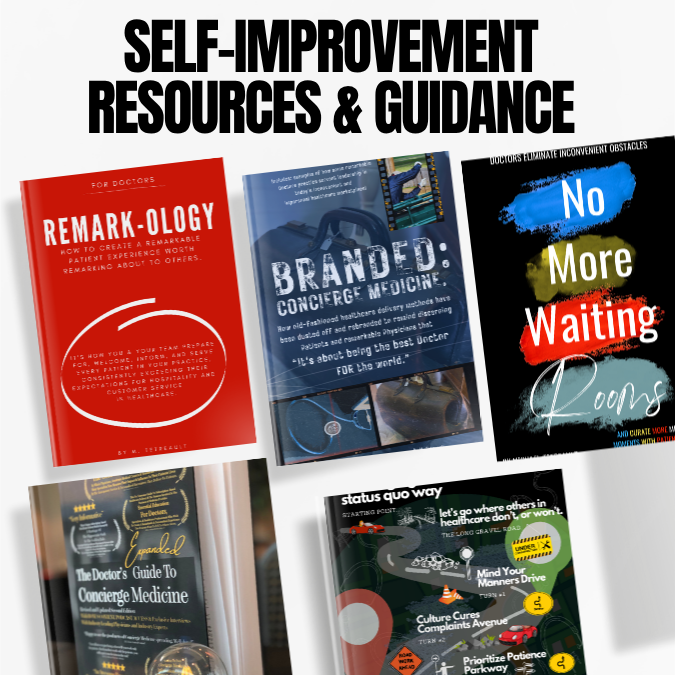
Culture cures complaints. But only if the physician leads the culture. That’s not a Turn #2 on a map. That is the practice design decision that determines every interaction that follows.
Sources:
- Al-Abri R, Al-Balushi A. “Patient Satisfaction Survey as a Tool Towards Quality Improvement.” Oman Medical Journal, 2014. https://pmc.ncbi.nlm.nih.gov/articles/PMC3096184/
- Levinson W, et al. Cited in: Stein T, et al. “‘Best Practice’ for Patient-Centered Communication: A Narrative Review.” Journal of Graduate Medical Education, 2013. https://pmc.ncbi.nlm.nih.gov/articles/PMC3771166/
- Kee JWY, et al. “Communication Skills in Patient-Doctor Interactions: Learning from Patient Complaints.” Education in Medicine Journal, 2018. https://www.sciencedirect.com/science/article/pii/S2452301116301225
- Gillespie A, Reader TW. “Healthcare Professionals’ Responses to Complaints: A Qualitative Interview Study.” Health Expectations, 2024. https://pmc.ncbi.nlm.nih.gov/articles/PMC11625874/
Concierge Medicine Today is an independent editorial publication. All content is educational and informational in nature and does not constitute medical, legal, financial, or accounting advice. #FORDoctors
Discover more from Concierge Medicine Today
Subscribe to get the latest posts sent to your email.
Categories: National Headlines