

If you’re feeling the pushback right now, misunderstood patients, skeptical colleagues, a community that hasn’t taken the time to understand what you’re actually building, hear this: you are not doing something wrong. You are likely doing something right, and doing it in public, where it’s harder.
By Michael Tetreault, Editor-in-Chief
The Cost Nobody Warns You About
When a physician commits to building a relationship-driven, membership-based practice, the pressure that follows is predictable. Some patients who can’t or won’t join will feel left behind.
 Worse yet, colleagues who stayed in the fee-for-service system will assume the worst about your motives. Either that, or they’ll quietly envy your courage.
But somewhere in your community, someone will inevitably say the word “elitist” before they ever ask a question about you, or even how the business model actually works.
I’ve watched this pattern play out for more than two decades of covering this space. I’ve taken the difficult questions and answered all the emails from a media that isn’t always friendly toward the idea. My role has always been to tell your story, good, bad, or indifferent. That’s my job. I’m in journalism and public relations. And, I’ve talked to enough physicians and industry leaders, including most, if not all, of the earliest and most outspoken pioneers of this model, to know the pressure never fully goes away. It just changes shape as the practice grows.
Building an outward-facing, patient-first practice isn’t a one-time act of courage. It’s a repeated daily decision. You disrupt comfort, your own and everyone else’s, for the sake of the mission. The drift toward the easy explanation is always there: blame it on a broken system. But patients don’t care about that, in fact, they resent you for not working with it. They pay their premiums each month and walked into your practice expecting you to do exactly what you’re doing — helping patients and dealing with the challenges, because well, that’s just life. Or, as my grandmother used to say to my cousin and I “Suck it up buttercup.”
The resistance is always real. But so is the fruit. And so is the reason most of you got into this business and mission-driven healthcare space in the first place.
As I’ve said many times over the years, ‘I’m not a physician, I’m a patient. And the perspective that gives me is that I know what it’s like to sit on the other side of you.’ So here’s what I think, from a patient’s perspective, every concierge and membership-based physician needs to hear right now.
1. Clarity Divides Before It Unites
The moment you clearly explain what your practice is, and just as important, what it is not, some people will pull away. That’s human nature. We resist and critique things we don’t understand. It’s a behavioral brain function that protects us. That’s not a sign you’ve done something wrong. It’s usually a sign you’ve finally been clear.
Donald Miller’s StoryBrand framework makes a point that applies directly here, and I just love it: confused people don’t buy, and confused communities don’t trust.
Vague explanations do the opposite of what you intend. Hedging on why you left a broken system, or why this subscription or membership is the solution can just make you look for lack of a better word, weak and selfish, and, furthermore, actually create more suspicion than sharp, honest clarity does. You see, when you stop hedging and start clearly stating your “why,” you’ll lose some people who were never going to be a fit anyway.
That loss can feel like failure. Let me encourage you today by reminding you it’s usually the opposite.
2. Being Misunderstood Hurts More Than Being Opposed
 Opposition is often loud and easy to identify. But as the movie Scream from the 90’s put it best, sometimes “the call is coming from inside the house.” Criticism today doesn’t always come from the community, from patients, or from onlookers. Often it comes from other physicians and peers unwilling to consider a different model. They’d rather criticize something they don’t understand, balk at the price tag and cite the Hippocratic Oath to you (like you can’t remember, right?!), retreat into their own circles, and blame “the system” for problems they built themselves, years ago.
Misunderstanding is quieter, and it cuts deeper. A patient who openly disagrees with your model is easier to sit with than a patient who quietly assumes you abandoned them for money.
This is the wound most physicians don’t talk about publicly. It’s not the online comment calling concierge medicine “healthcare for the rich.” It’s the longtime patient who doesn’t ask a single question, doesn’t come to the information session, and just quietly leaves, convinced they already know your reasons. Jeff Henderson, my mentor, says it this way: you can’t control what people assume, but you can control what you’re known for. Clarity, consistency, and showing up for the whole community over time are the only real answers to being misunderstood when operating a concierge medicine practice today, regardless of your price point or brand terminology you put on your web site.
3. Distrust Escalates in Stages, and the Real Complaint Is Rarely the First One
In my conversations with physicians navigating this transition over the years, a pattern shows up again and again. The first complaint is almost always about the fee. “Why are you charging for something that used to be covered by insurance (or as they understand it, free).” That’s rarely the real concern underneath it.
Give it time, and the second complaint surfaces. “Why did you choose money over us.” That’s closer to the truth for some, but it’s still not the center of it. The complaint about “how,” the fee, the structure, the paperwork, is usually a stand-in for a much more personal concern about “why.”
Instead, it’s actually this: Do you still care about me as a patient, or was I just a number.
Physicians who understand this distinction stop trying to win the fee argument and start addressing the trust question directly. That’s a fundamentally different conversation, and it’s the one that actually rebuilds the relationship.
4. Staying Focused on the Patient, Not the Politics of the Model, Is What Unites a Divided Community
Concierge and membership medicine (or even its distant cousin, direct primary care) has become a genuinely polarizing topic in some circles. Health policy debates, insurance industry pushback, and broader arguments about access to care, fees, etc., all get poured onto these membership models like gasoline to a fire. Often by people who have never sat across from a physician trying to give a patient more than seven to twelve minutes of attention.
The physicians who navigate this well don’t spend their energy defending the model as an ideology. They spend it on the patient in front of them. As one guiding principle at Concierge Medicine Today and the Concierge Medicine puts it: “It is no longer about being the best doctor in the world, but about being the best doctor for the world, for patients, and for the local community.” That framing doesn’t ask you to win an argument about healthcare policy. It asks you to keep showing up for the people you serve. That’s what actually brings a skeptical community back around, not a better talking point.
5. The Real Danger Was Never Opposition. It’s Isolation.
This is the point I most want every physician reading this to sit with.
Pushback is uncomfortable, but it’s survivable, and it’s often even useful. It forces clarity you didn’t have before. What isn’t survivable, long term, is doing this work alone. Physicians who try to hold the line in isolation, without peers who understand the specific pressures of building a relationship-driven practice, burn out or quietly drift back toward the models that made them miserable in the first place.
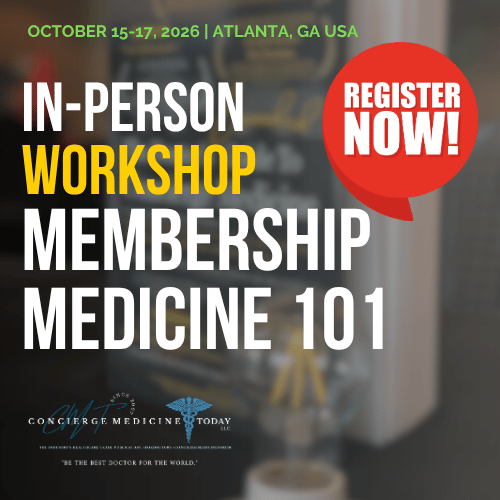
This is precisely why the Concierge Medicine Forum exists. Not as a cheerleading conference, and not as a stage for vendor pitches dressed up as education, but as a room full of physicians (often their spouses too!), who have held the line themselves and are willing to talk honestly about what it costs.
A Story Worth Remembering
 A few years ago, I interviewed a concierge physician in a mid-sized community who was regularly criticized, sometimes in local op-eds, for running a “boutique practice that only the wealthy could afford.” Rather than respond publicly, she quietly started opening her office one Saturday a month, unpaid, for uninsured patients referred by the local free clinic. No press release. No marketing campaign. Just hours she didn’t have to give, given anyway.
Word got around eventually, not because she told anyone, but because her patients did. The op-eds didn’t stop entirely. But the tone of the community changed. People stopped assuming they knew her “why.”
That’s the thing about holding the line. It’s rarely won in an argument. It’s won in the quiet, repeated decisions nobody sees at first.
Bonus: Physicians Aren’t the Only Ones Who’ve Had to Hold the Line
If this pattern feels familiar, it should. Outside of medicine, some of the most recognizable businesses in the country have absorbed the exact same criticism for the exact same reason: they got clear about who they were, and clarity always costs something up front.
Chick-fil-A has closed its doors every Sunday since it opened, a decision that by any conventional retail logic leaves real revenue on the table every single week. For years, competitors and analysts framed it as a business mistake. It wasn’t a mistake. It was a line the founder drew and never moved, and it became one of the most recognized brand identities in American fast food, not despite the closure, but partly because of it.
Netflix took a beating in 2011 when it split its DVD and streaming businesses into two separate services and price plans. Customers were furious. Subscribers canceled in large numbers, and the company’s stock dropped sharply in the months that followed. The leadership team held the position anyway, betting that streaming was where the business had to go even though the immediate reaction was overwhelmingly negative. The short-term pushback was real. So was the long-term direction they were right to hold.
In-N-Out Burger has kept a stripped-down menu for decades while competitors chased trend after trend, adding items, launching limited-time offers, and expanding footprints aggressively. In-N-Out grew slowly and deliberately instead, and turned “we don’t do that here” into part of its identity rather than a limitation. The narrow menu isn’t a lack of ambition. It’s a line held on purpose.
None of these companies avoided criticism by being clear. They got criticized precisely because they were clear. The difference between the businesses that fold under that pressure and the ones that become known for something is almost never the criticism itself. It’s whether leadership held the line long enough for the market, or the community, to understand why the line was there.
Concierge and membership-based medicine today is no different. The physicians who hold their model steady, explain it clearly, and keep serving the patient in front of them are doing the same thing Chick-fil-A, Netflix, and In-N-Out did in their own industries. It rarely feels like strategy in the moment. It just feels like holding on. But it’s the same principle, applied to healthcare instead of hamburgers.
Learn. Build. Lead.
If you’re feeling the pushback right now, misunderstood patients, skeptical colleagues, a community that hasn’t taken the time to understand what you’re actually building, hear this: you are not doing something wrong. You are likely doing something right, and doing it in public, where it’s harder.
Hold the line anyway.
Michael Tetreault is Editor-in-Chief of Concierge Medicine Today, host of the industry’s weekly podcast, The DocPreneur Leadership Podcast, and organizer of the industry’s annual medical education conference, the Concierge Medicine Forum.
Discover more from Concierge Medicine Today
Subscribe to get the latest posts sent to your email.
Categories: National Headlines