

More than a decade of patient research finds that relationship and trust, not cost or convenience, remain the primary reason patients seek a concierge physician.
 FOR IMMEDIATE RELEASE
ATLANTA, GA, September 23, 2026. Concierge Medicine Today (CMT), the independent trade publication for physicians in concierge and membership-based care since 2007, today announced the publication of the CMT Patient Study, a proprietary patient psychographic model built from CMT’s patient-inquiry survey data collected between January 2013 and December 2024. CMT also launched the Physician-Patient Archetype Test, a free two-minute self-assessment that helps physicians identify their natural leadership style and the patient type most likely to recognize them as a trusted guide.
Key findings
The study draws on an archive of more than 7,300 patient conversations from individuals actively searching for a concierge or membership-based physician through CMT’s channels. Among its findings:
- Relationship comes first, and has for more than a decade. Among 1,149 patients asked the same direct question across the full archive, 74.3% of respondents from 2013 to 2018 (n=416) and 74.5% from 2019 to 2024 (n=733) named finding a doctor they like and trust as their top reason for searching.
- Feeling like a number is the leading reason patients leave. It was the most-cited reason for leaving a prior doctor, ahead of wait times and cost (n=1,085).
- Physician relationship matters to access decisions. 52% said they would still choose an M.D. alone over N.P. or P.A. access, even when speed was offered as a trade-off (n=1,993).
- Families search together. One in ten searches were conducted on behalf of a family member, a pattern present in every patient group (n=4,088).
- Hospitality is expected, not differentiating. Hospitality and service expectations were rated highly by nearly every respondent, indicating a baseline expectation of the category rather than a dividing line within it.
Two questions, four patient types
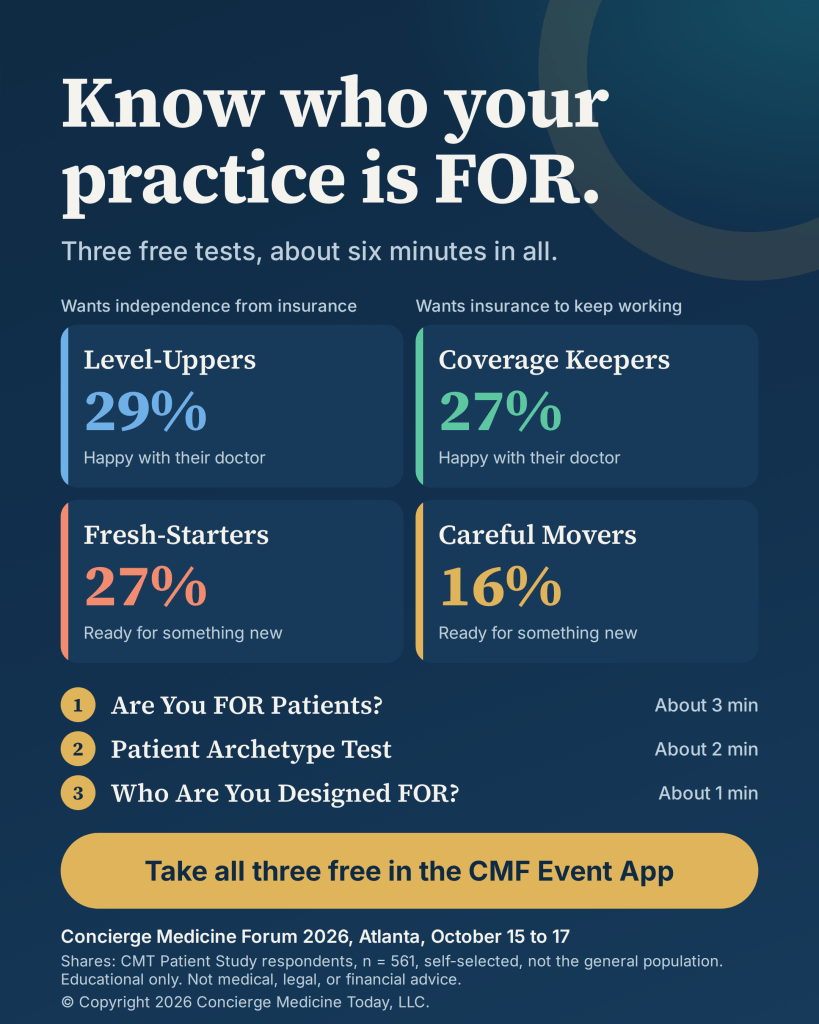
CMT tested numerous variables, including age, income signals, geography, referral source, and specialty need. Most did not produce a meaningful split. Two questions did: whether a patient is happy with their current doctor or ready for something new, and whether they want their next doctor to remain compatible with insurance and Medicare or want independence from that system.
Based on 561 patients who answered all four rating questions between 2018 and 2024, CMT identified four patient types:
- Level-Uppers (29%). These patients rate their current doctor highly (trust 4.23, like 4.19 of 5) but place low importance on insurance compatibility (2.21 of 5). They are not fleeing a bad relationship. They have outgrown what their insurance-based doctor can offer and believe healthcare should adapt to the patient. This group skews Baby Boomer and Gen X, with a meaningful Millennial share, and has the youngest average age of the four.
- Coverage Keepers (27%). These patients trust and like their current doctor (4.38 / 4.40) and place the highest importance on insurance or Medicare compatibility of any group (4.67 of 5). They want the concierge experience added to a relationship that already works, not traded for it. This is the oldest-skewing group, heavily Baby Boomer.
- Fresh-Starters (27%). These patients report low trust and connection with their current doctor (2.65 / 2.56) and little interest in insurance compatibility (2.34). They are ready to leave both the relationship and the system at once, and are the most likely of the four to cite feeling like a number as their reason for leaving. This group spans generations fairly evenly.
- Careful Movers (16%). These patients are unhappy with their current doctor (2.60 / 2.60) but still need insurance or Medicare to work (4.64). The smallest and most constrained group, they are solving two problems at once: finding a better doctor without losing the coverage they depend on. This group skews older and is more likely than any other to be managing a chronic condition.
“Underneath four very different answers, every one of these patients is looking for the same thing: somewhere to belong, with someone who actually sees them,” said Michael Tetreault, Editor-in-Chief of Concierge Medicine Today. “That part never changed in eleven years, and I don’t expect it to.”
Consistent with independent research
The study’s central finding aligns with a peer-reviewed literature on continuity of care, which has associated an ongoing relationship with a consistent physician with higher patient trust (Mainous et al., Family Medicine, 2001) and lower total health care costs (De Maeseneer et al., Annals of Family Medicine, 2003), and has identified interpersonal trust as a mechanism through which continuity produces its benefits (Tarrant et al., Annals of Family Medicine, 2010). A systematic review also found higher continuity of doctor care associated with lower mortality in 18 of 22 studies (Pereira Gray et al., BMJ Open, 2018). These studies were conducted independently of CMT, do not study concierge or membership medicine specifically, and establish association rather than causation.
The Physician-Patient Archetype Test
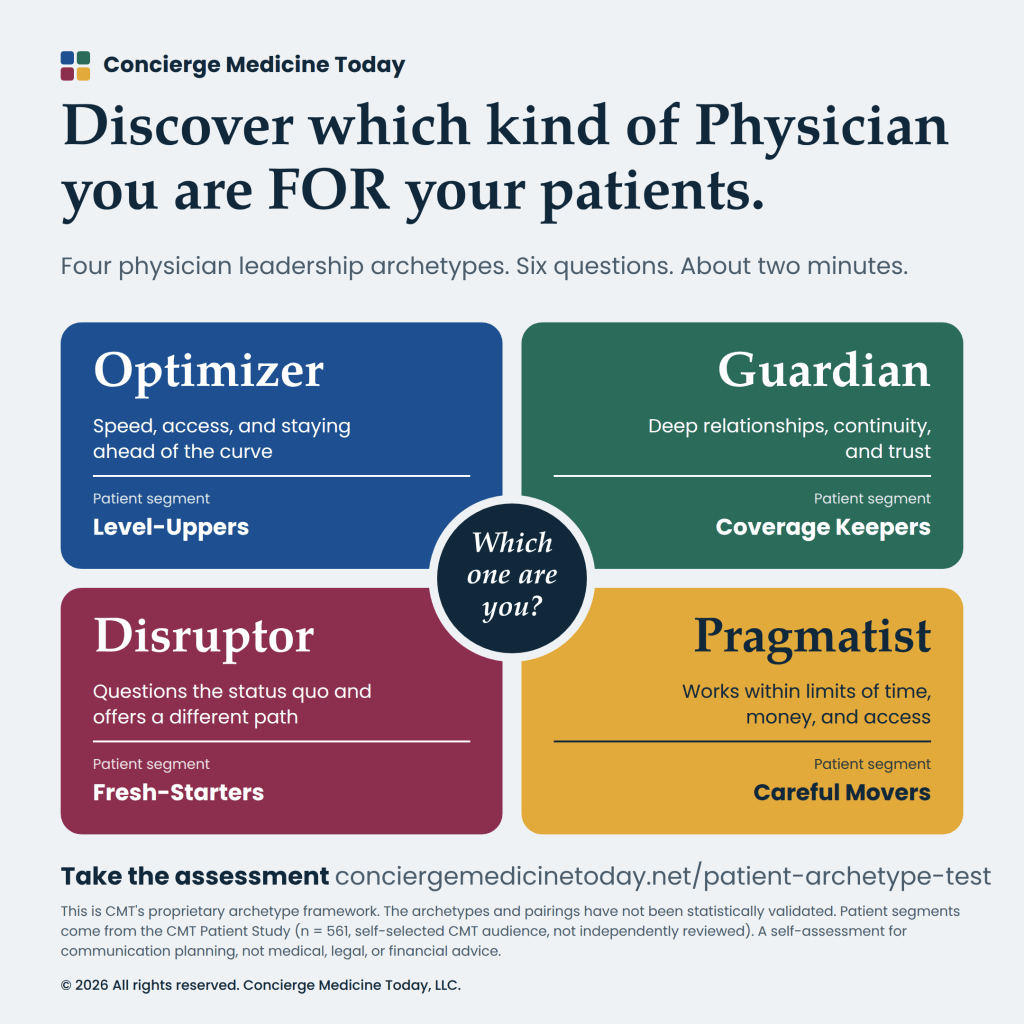
Alongside the study, CMT developed four physician leadership archetypes, each paired with a patient type: Optimizer with Level-Uppers, Guardian with Coverage Keepers, Disruptor with Fresh-Starters, and Pragmatist with Careful Movers. The pairing is a CMT hypothesis that trust may come more easily when a physician’s natural way of leading aligns with what a patient is looking for. The Patient Study does not test this pairing, and the archetypes, an adaptation of archetype thinking from Carl Jung and from Margaret Mark and Carol Pearson’s brand-strategy work, have not been statistically validated.
How to take the test:
Visit conciergemedicinetoday.net/patient-archetype-test. Physicians answer six questions about what energizes them, how they naturally lead, and what they value. The test takes about two minutes. Results show the physician’s primary archetype (or a blend, if archetypes tie), how strongly each archetype pulled, a blind spot to watch, and the patient type most likely to recognize them as their guide. Answers are processed in the physician’s browser and are not sent to CMT.
“You can’t be FOR every patient with the same headline,” Tetreault said. “The practices that grow aren’t the ones with the cleverest tagline. They’re the ones who finally figured out which patient they’re actually talking to.”
Practical next steps for practices
CMT recommends three steps: tag recent patient inquiries by how patients feel about their current doctor and whether insurance matters to them, since most practices will find one or two types dominate their local market; tailor messaging to the specific patient type rather than relying on a single amenity list; and record each new patient’s type at intake to build practice-specific evidence over time.
 Scope
Scope
The CMT Patient Study concerns concierge and membership medicine, including traditional retainer-based and hybrid models. It deliberately excludes Direct Primary Care (DPC), a structurally distinct model, and DPC-indicating responses were not included in the analyzed sample. That will be analyzed and published at a later date.
Availability
The CMT Patient Study, the full published research article, and the Physician-Patient Archetype Test are available now:
- Patient Study: conciergemedicinetoday.net/cmt-patient-study
- Full research article: conciergemedicinetoday.net/cmt-patient-study-article
- Archetype Test: conciergemedicinetoday.net/patient-archetype-test
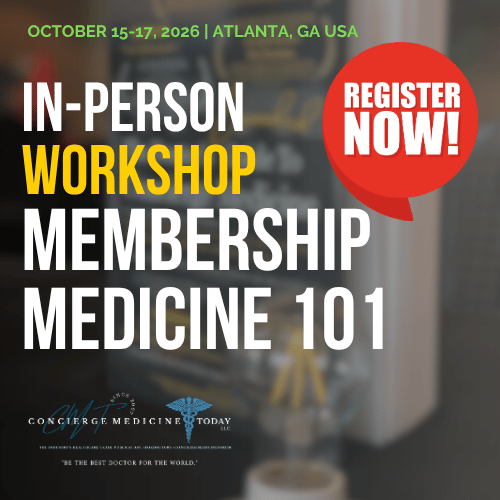
Learn more about the upcoming October 2026 “Membership Medicine 101” and “Marketing Membership Medicine 101” Workshops happening at the industry’s annual medical education conference, the Concierge Medicine Forum in Atlanta.
About Concierge Medicine Today
Concierge Medicine Today is the independent trade journal and educational platform for physicians, clinicians, and healthcare professionals in concierge and membership-based care. Founded in 2007, CMT is not owned or controlled by any health system, hospital network, vendor, or membership association, and reports on the full range of practice models and ownership structures in the field. CMT produces the Concierge Medicine Forum, the field’s annual leadership conference.
Media Contact
Concierge Medicine Today
conciergemedicinetoday.net/media-desk
Sources
- Concierge Medicine Today, LLC. The CMT Patient Study. Data collected 2013–2024; published 2025–2026. https://conciergemedicinetoday.net/cmt-patient-study (first-party research, not independently peer reviewed)
- Tetreault, M. Your Patients Aren’t One Audience. They’re Four. Concierge Medicine Today, 2025–2026. https://conciergemedicinetoday.net/cmt-patient-study-article
- Mainous, A. G. 3rd, Baker, R., Love, M. M., Gray, D. P., & Gill, J. M. (2001). Continuity of care and trust in one’s physician: evidence from primary care in the United States and the United Kingdom. Family Medicine, 33(1), 22–27.
- De Maeseneer, J. M., De Prins, L., Gosset, C., & Heyerick, J. (2003). Provider continuity in family medicine: does it make a difference for total health care costs? Annals of Family Medicine, 1(3), 144–148.
- Tarrant, C., Dixon-Woods, M., Colman, A. M., & Stokes, T. (2010). Continuity and trust in primary care: a qualitative study informed by game theory. Annals of Family Medicine, 8(5), 440–446.
- Pereira Gray, D. J., Sidaway-Lee, K., White, E., Thorne, A., & Evans, P. H. (2018). Continuity of care with doctors: a matter of life and death? BMJ Open, 8(6), e021161. https://bmjopen.bmj.com/content/8/6/e021161
- Mark, M., & Pearson, C. S. (2001). The Hero and the Outlaw. McGraw-Hill. ISBN 0071364153.
- Jung, C. G. (1969). The Archetypes and the Collective Unconscious (2nd ed.). Princeton University Press. ISBN 0691097615.
Methodology and Disclaimers
The CMT Patient Study is built exclusively from Concierge Medicine Today’s own patient-inquiry survey and has not been reviewed by outside researchers. Respondents are a self-selected group of individuals who searched for a concierge or membership physician through CMT’s channels, not a probability-based or nationally representative sample. The four-type model is based on 561 respondents from 2018 to 2024, when the relevant rating questions were added; other figures come from separate, differently sized respondent pools, as noted, and older responses may reflect a healthcare landscape that has since changed. The open-ended trend comparison was derived by grouping similar free-text answers and should be read as a directional signal. Patterns described are correlations, not claims of causation. This is a working, early-stage model that CMT plans to test and refine with a purpose-built survey, and figures may change.
The Physician-Patient Archetype Test is a self-assessment for clarity and communication planning. It is not a diagnostic, psychological, or clinical tool and does not measure competence or quality of care. Results are self-reported and not independently verified. Reference to third-party authors and frameworks does not imply their endorsement.
Content is educational and informational only and does not constitute medical, legal, financial, accounting, or tax advice. Physicians should consult qualified professionals before making decisions about marketing, pricing, insurance participation, Medicare compliance, or business structure. CMT is independent and does not favor any practice model.
The CMT Patient Study, its four-segment patient model, the psychographic type names, the four-segment physician model, type names and the CMT assessment tools built on them are proprietary to Concierge Medicine Today, LLC. © 2007–2026 Concierge Medicine Today, LLC. All rights reserved.
###
Discover more from Concierge Medicine Today
Subscribe to get the latest posts sent to your email.
Categories: National Headlines