
From the perspective of a patient—someone who relies on physicians every day—your leadership matters now more than you may realize. Each spring, a new class of physicians completes training and steps into independent practice, a transition filled with excitement, pressure, and uncertainty. Here are a few reflections on humility, leadership, time, business literacy, and what concierge medicine has taught us about restoring the physician-patient relationship.
By Michael Tetreault
Editor-in-Chief, Concierge Medicine Today
Each spring, a new class of physicians completes residency and fellowship training and steps into the next chapter of their careers.
The final weeks of training are often filled with logistics—credentialing paperwork, preparing for a new role, relocating to a new city, or studying for boards. It can feel like a sprint toward the next phase.
But this short transition period is also something else.
It’s a rare professional pause.
A moment between two demanding seasons of a medical career.
Before stepping fully into your next role, it may be worth slowing down—just for a moment—and reflecting on what this season represents.
And to be clear, these reflections come from someone who is not a physician. They come from someone who has spent years listening to physicians, studying healthcare delivery, and experiencing the healthcare system from the other side of the exam table—as a patient.
That perspective shapes much of what follows.
Finish Your Training with Intention
As the end of training approaches, it can be tempting to mentally move on before the final shift is complete.
But professionalism is often most visible in the final stretch.
Patients still need thoughtful care. Teams still rely on your presence. Colleagues still benefit from your engagement.
Finishing well isn’t simply about completing a program requirement—it reflects the kind of physician and colleague you choose to be.
In medicine, reputation is rarely built in dramatic moments.
It’s built quietly, through consistent actions over time.
Pause and Recognize the Moment
Medical training can feel long while you’re in it.
But many physicians later describe it as a blur of years filled with learning, pressure, friendships, and growth.
Before the transition happens, pause.
Walk through the hospital or clinic one more time with a different perspective.
Notice the places where you struggled early in training but eventually found your rhythm.
Remember the mentors who challenged you.
Remember the patients who trusted you when you were still learning.
These years shaped far more than your clinical knowledge.
They shaped how you think, how you collaborate, and how you care.
Express Gratitude to the People Who Helped You Get Here
Few careers are built alone—and medicine is no exception.
Think about the people who supported your journey:
• mentors who challenged you to grow
• nurses and care teams who helped you navigate complex cases
• program leaders who advocated for your progress
• family members who supported the long hours and sacrifices
Taking the time to acknowledge those contributions—sometimes with something as simple as a handwritten note—can mean more than you might realize.
Healthcare is hard work. It always will be. But it becomes far more meaningful when people feel appreciated.
Just don’t forget the power of a handwritten note as you age.
Avoid the Comparison Trap
Graduation season often brings comparisons.
Some classmates will pursue academic medicine. Others will join large health systems, private practice groups, startups, or relationship-focused models like concierge medicine.
Compensation, geography, and career paths will vary widely.
But careers in medicine rarely follow identical timelines.
A fulfilling professional life is built over decades—not determined by the first position after training.
Run your race.
Focus on building a career aligned with your values, interests, and long-term goals.
Avoid the “MD-eity” Mindset
Earning the title of physician is an extraordinary achievement.
But the letters after your name are not meant to elevate you above the people around you.
Occasionally medicine drifts toward what some jokingly call the “MD-eity mentality”—the idea that the degree itself guarantees authority or status.
The physicians patients respect most rarely think this way.
They demonstrate humility.
They listen to their teams.
They treat nurses, staff, and patients with genuine respect.
Leadership in medicine isn’t rooted in hierarchy.
It’s rooted in trust.
Don’t Become Subservient to a Broken System
You will hear many conversations about how broken healthcare can feel.
And there are real structural challenges physicians face.
But early in your career, it’s easy to fall into one of two traps:
• constant cynicism about the system
• complete submission to it
Neither approach leads to progress.
Some of the most innovative physicians in recent decades didn’t simply complain about healthcare.
They redesigned aspects of it.
Concierge and membership-based medicine are examples of physicians experimenting with new ways to restore time, relationships, and continuity of care.
These models aren’t the answer for every physician.
But they demonstrate something important:
Healthcare systems are not fixed.
They can evolve.
And physicians often lead that change.
Learn the Business of Medicine
Medical school and residency prepare physicians extraordinarily well for clinical care.
But most physicians receive little training in how healthcare organizations actually function.
Understanding the business side of medicine does not make a physician less patient-focused.
In many cases, it allows them to serve patients more effectively.
Areas worth learning about include:
• healthcare economics and reimbursement systems
• practice operations and staffing models
• patient experience design
• leadership and team management
• physician entrepreneurship and innovation
Physicians who understand both clinical care and operational systems are often better equipped to improve them.
What Concierge Medicine Has Taught Us
Over the past two decades, concierge and membership-based practices have provided valuable insights about what healthcare looks like when time and relationships are prioritized.
Several themes consistently emerge:
Smaller patient panels
Many concierge physicians care for roughly 400–800 patients, compared with traditional primary care panels that may exceed 2,000 patients.
Longer appointments
Visits often last 30–60 minutes, allowing deeper conversations about prevention, lifestyle, and long-term health.
Greater physician autonomy
Physicians regain more control over scheduling, staffing, and practice operations.
Stronger physician-patient relationships
Smaller panels often lead to deeper continuity of care.
Improved physician sustainability
Many physicians report lower administrative burden and improved work-life balance.
These lessons are influencing broader conversations about how healthcare can evolve.
Medicine Is Both Science and Service
Clinical expertise is essential.
But from a patient’s perspective, something else matters deeply as well: how they are treated.
Patients remember whether they felt heard.
They remember whether the physician took time to explain.
They remember whether they felt respected.
Across healthcare—and especially within relationship-centered models—physicians are rediscovering something important:
Care is both technical and human.
Listening, empathy, communication, and respect are not soft skills.
They are core components of excellent medicine.
Protect Your Time Early in Your Career
Many experienced physicians eventually learn the same lesson:
Time becomes the most valuable resource in a medical career.
Author of Buy Back Your Time, entrepreneur and leadership advisor Dan Martell often emphasizes the importance of protecting time and energy as a professional discipline.
For physicians, that can mean:
• establishing healthy boundaries early
• protecting time for family and personal recovery
• designing sustainable schedules when possible
• recognizing early signs of burnout
Medicine requires dedication.
But long careers require sustainability.
The “Sunday Scaries” Are Real
Many early-career professionals—including physicians—experience what has become known as the Sunday Scaries.
It’s that feeling of anxiety that creeps in before the start of a new workweek.
For physicians early in their careers, that feeling can come from:
• the weight of responsibility for patients
• steep learning curves
• demanding schedules
• fear of making mistakes
If you feel that occasionally, you’re not alone.
Confidence in medicine grows through experience.
Supportive colleagues, strong mentorship, and healthy routines outside of medicine can make an enormous difference.
Medicine is demanding.
But it should not require sacrificing your wellbeing to practice it.
Celebrate the People Around You
Graduation is rarely an individual accomplishment.
Your classmates, co-residents, and fellows experienced the same long nights, difficult cases, and milestones alongside you.
Take time to celebrate their achievements.
Encourage their success.
Medicine benefits from professional communities that support one another.
Stay Curious About the Future of Healthcare
Healthcare is evolving quickly.
New care models are emerging. Technology is reshaping workflows. Patients are seeking more personalized care experiences.
Physicians who remain curious about healthcare beyond clinical science often become the leaders who shape its future.
Areas worth exploring include:
• healthcare systems and economics
• patient experience
• practice design
• leadership and communication
Graduation from training is not the end of learning.
In many ways, it marks the beginning of a different kind of education.
Books Physicians May Find Helpful
Many physicians discover that leadership, business, and time management become increasingly important throughout their careers.
A few widely respected books include:
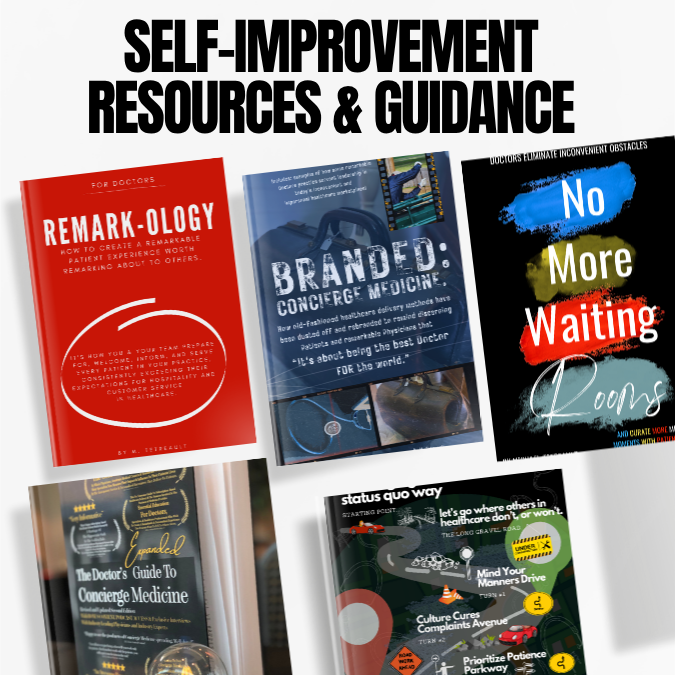
The Doctor’s Guide to Concierge Medicine: 2nd Edition — Michael Tetreault
From pro tips and insider chats to lessons learned if you had to go it all over again, this book is your guide to blending old-fashioned healthcare with modern day expectations.
Marketing Your Brand of Membership Medicine (Softcover) — Michael Tetreault
How old-fashioned healthcare delivery methods have been dusted off and rebranded to remind discerning Patients and remarkable Physicians that “It’s about being the best Doctor FOR the world.”
Buy Back Your Time — Dan Martell
A framework for protecting time and focusing on high-value work.
Unreasonable Hospitality — Will Guidara
A powerful exploration of service and experience—ideas that translate remarkably well into patient care.
Remark-ology — Michael Tetreault
Delivering an exceptional experience for your patients relies on several key elements: location, staff, availability, signage, facilities, and the overall feel of the practice.
The Motive — Patrick Lencioni
A short but meaningful reflection on why leadership matters.
The Personal MBA — Josh Kaufman
A practical introduction to core business concepts.
No More Waiting Rooms — Michael Tetreault
Old-school marketing tells customers (i.e., patients) that you control the message. Today, that theory doesn’t hold water. New school marketing, especially in healthcare settings, says, “The customers (i.e., patients) inform others about you.”
The Innovator’s Prescription — Clayton Christensen, Jerome Grossman, Jason Hwang
A thoughtful exploration of how healthcare systems can evolve through innovation.
A Final Thought
Medicine offers something few professions do.
You will walk into rooms where people are scared.
You will meet families during some of the most vulnerable moments of their lives.
And you will have the opportunity—often quietly, sometimes profoundly—to make those moments better.
Approach that responsibility with humility.
Stay curious.
Protect your humanity.
Your training prepared you to practice medicine.
Your leadership will help shape what medicine becomes next.
And from the perspective of patients—people who rely on physicians every day—that leadership matters more than you may realize.
Discover more from Concierge Medicine Today
Subscribe to get the latest posts sent to your email.
Categories: Healthy Leadership Practices, National Headlines