

We didn’t stop at finding this pattern once. We checked it against 1,149 patients across the full archive, 416 from the early years of our data (2013 to 2018) and 733 from the recent years (2019 to 2024), asking the exact same question both times: what matters most to you?
 By Michael Tetreault, Editor-in-Chief, Concierge Medicine Today
You know your medicine. Do you really know your practice?
Most physicians can explain their care in one sentence. Far fewer can say, honestly, whether their patients trust them, whether their marketing is actually reaching the people it’s meant for, or whether someone quietly unhappy is about to leave without ever telling you why.
For eleven years, Concierge Medicine Today has been asking the people who matter most: the patients themselves. Why are you searching for a new doctor. Why are you leaving your last one. What matters most to you when you’re choosing who to trust with your care. Over seven thousand patient conversations later, collected between 2013 and 2024, a pattern emerged that we didn’t expect, and it’s reshaping how we think this industry should market, welcome, and retain the patients it serves.
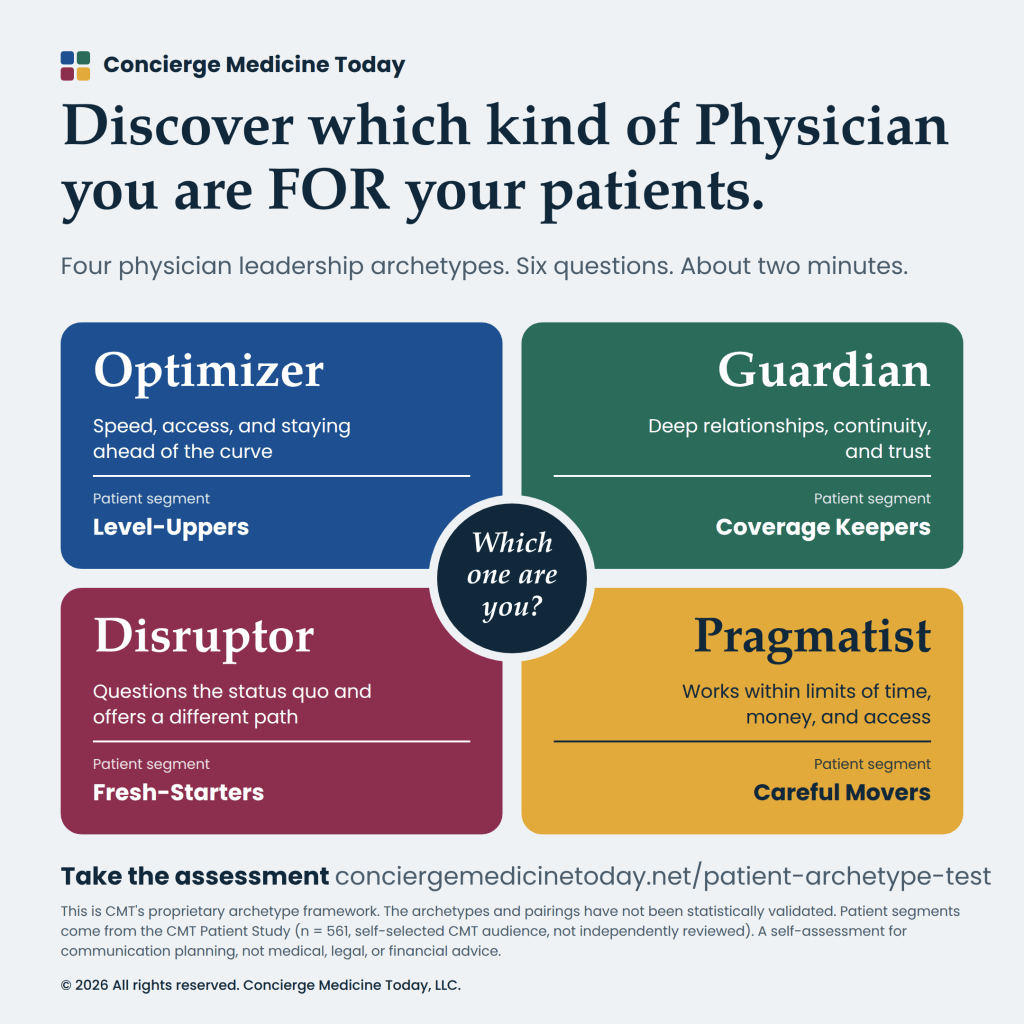
Concierge and membership medicine patients aren’t one audience. They’re four (LEARN MORE).

The Two Questions That Actually Matter
 We tested a long list of variables against the data: age, income signals, geography, how patients found us, even how much they cared about the physical office space. Almost none of it mattered as much as we assumed. Hospitality and service, for instance, turned out to matter to nearly everyone, which means it isn’t a dividing line at all. It’s table stakes.
Two questions, and only two, consistently separated patients into meaningfully different groups:
- How do they already feel about their current doctor? Happy, or ready for something new?
- What do they want from insurance? Do they want their next doctor to still work with insurance and Medicare, or do they want independence from that system entirely?
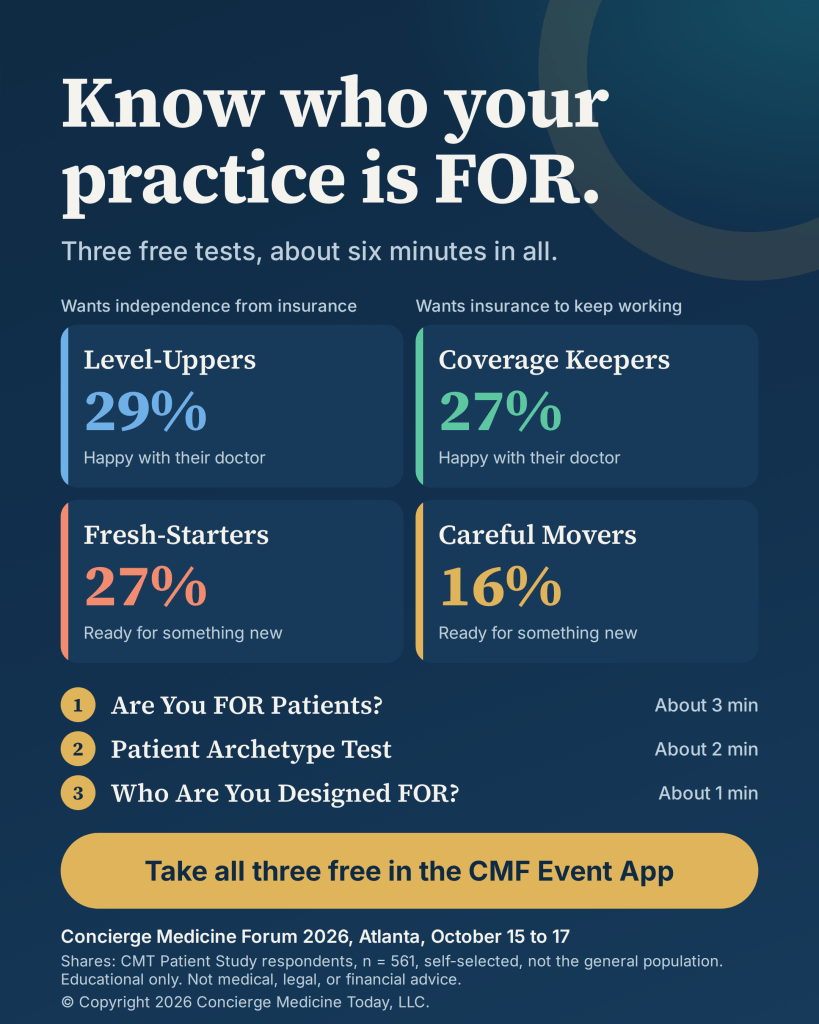
Plot patients on those two questions, and four distinct groups appear, drawn from 561 patients who answered every question behind this model.
The Four Types
 Level-Uppers, 29% of patients. These patients trust and like their current doctor (4.23 and 4.19 out of 5) but still want full independence from insurance (2.21 out of 5). They aren’t fleeing a bad relationship. They’re confidently reaching for something better before anything breaks. This group skews Baby Boomer and Gen X, with a meaningful Millennial presence, the youngest-skewing of the four.
- Coverage Keepers, 27% of patients. The most loyal group in the data, with trust and like scores of 4.38 and 4.40, and the single highest insurance-importance score of any group we measured, 4.67. They aren’t leaving anyone. They want the concierge experience added to a relationship they already trust, not traded away for it. The oldest-skewing group, heavily Baby Boomer.
- Fresh-Starters, 27% of patients. Low trust and connection with their current doctor (2.65 and 2.56) and little interest in insurance compatibility (2.34). They’re done compromising with the relationship and the system at the same time. This group spans every generation fairly evenly, and they are the most likely of the four to say, in their own words, that they’re leaving because they feel like a number.
- Careful Movers, 16% of patients, the smallest group. Unhappy with their current doctor (2.60 and 2.60) but still needing Medicare or insurance to work, 4.64, nearly the highest score in the entire dataset. This is a patient solving two problems at once: a doctor who isn’t working, and a financial reality that has to keep working. That’s a harder position than any other group faces, which is likely why they tend to be the most time-pressured to find a fit.
Ten Years of Proof, Not a Guess
We didn’t stop at finding this pattern once. We checked it against 1,149 patients across the full archive, 416 from the early years of our data (2013 to 2018) and 733 from the recent years (2019 to 2024), asking the exact same question both times: what matters most to you?
The answer: 74.3% in the early years. 74.5% in the recent years. Virtually unchanged.
For eleven straight years, roughly three out of every four patients who came looking for a concierge or membership doctor were looking for a relationship first, not a perk, not a discount. That was true a decade ago. It’s true today. A separate, open-ended question tells the same story even more sharply: patients describing their search in their own words used relationship and trust language nearly three times as often in the recent years as in the early ones.
What This Means for Your Practice
 If you’re marketing to “the ideal concierge patient” as though there’s one of them, you’re likely speaking clearly to one of these four groups and mumbling to the other three.
A few things worth doing with this, starting this week:
- Tag your last twenty patient inquiries. How did they feel about their prior doctor? Did insurance come up, and how? Most practices find that one or two of these four types dominate their actual local market, not all four evenly.
- Write different messages for different problems. A Coverage Keeper needs reassurance about continuity. A Fresh-Starter needs permission to start over. The same headline will not land with both of them, no matter how well it’s written.
- Track results by type going forward, not just by lead count. A year of that data becomes your own practice-level proof of where this model holds, and where your market looks different from the national picture.
See Where Your Own Practice Fits
We built a free tool that applies this exact research to your own practice. It’s called the Patient Match Score, ten questions, about two minutes, and it tells you, from most to least likely, which of these four types your current positioning is actually attracting.
Take the Patient Match Score →
For the full research, methodology, and sourcing behind this model, see The CMT Patient Study.
This article is based on the CMT Patient Study, Concierge Medicine Today’s proprietary patient psychographic model, built from patient survey data collected 2013–2024. This is a self-selected sample of patients actively searching for a concierge or membership-based doctor through CMT’s own channels, not a nationally representative sample. Full methodology and disclaimers are available on the Patient Study page. Nothing in this article constitutes medical, legal, or financial advice. © 2007–2026 Concierge Medicine Today, LLC.
Discover more from Concierge Medicine Today
Subscribe to get the latest posts sent to your email.